49/08, Nirala Residential Area, Khulna
contact@digitalexpertit.com
←Back to Articles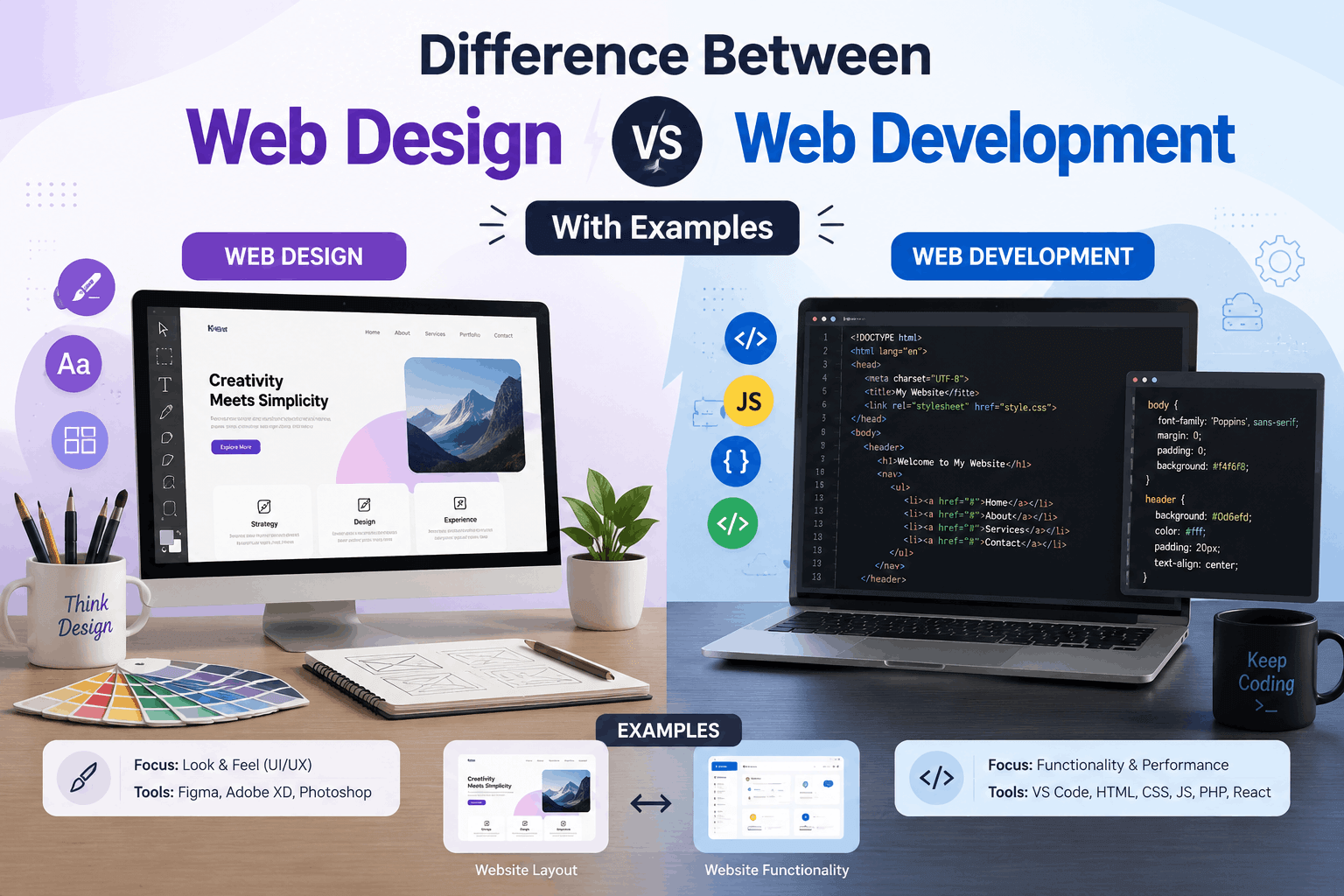 July 1, 20267 min read
Difference Between Web Design and Web Development (With Examples)
D
Digital Expert IT
Author
If you're planning to build a website for your business, you've probably come across two terms: web design and web development. Many people use them interchangeably, but they actually refer to two very different parts of creating a website.
Understanding the difference between web design and web development helps you make better decisions, whether you're hiring professionals, starting a new business website, or considering a career in the digital industry.
In this guide, we'll explain the differences in simple language, provide real-world examples, and help you understand how both work together to create successful websites.
What Is Web Design?
Web design focuses on the visual appearance and user experience of a website. A web designer plans how a website looks, feels, and interacts with visitors.
Think of a web designer as the architect of a house. They decide where everything should go before construction begins.
A web designer typically works on:
- Website layout
- Color schemes
- Typography
- Images and graphics
- User interface (UI)
- User experience (UX)
- Mobile responsiveness
- Navigation structure
The main goal is to create a website that is attractive, easy to navigate, and enjoyable to use.
Example of Web Design
Imagine you own a bakery.
A web designer will create:
- A beautiful homepage with your bakery's branding
- Attractive product galleries
- Easy-to-read menus
- Call-to-action buttons like "Order Now"
- A responsive design that looks great on mobile devices
Everything visitors see and interact with visually is part of web design.
What Is Web Development?
Web development is the process of turning a website design into a fully functional website.
Developers write the code that powers the website. They ensure every button works, forms send information correctly, pages load quickly, and databases function properly.
If web design is the blueprint, web development is the construction process.
Web development generally includes:
- Front-end development
- Back-end development
- Database management
- Server configuration
- Website security
- API integration
- Performance optimization
Developers use programming languages such as:
- HTML
- CSS
- JavaScript
- PHP
- Python
- Node.js
- React
- Laravel
Example of Web Development
Let's return to the bakery example.
A developer would:
- Build the online ordering system
- Connect payment gateways
- Store customer orders in a database
- Create user login functionality
- Make contact forms work
- Improve page speed
- Secure customer information
These features work behind the scenes and aren't always visible to visitors.
Web Design vs Web Development: Key Differences
|
Web Design |
Web Development |
|
Focuses on appearance |
Focuses on functionality |
|
Creates layouts and visuals |
Writes code |
|
Improves user experience |
Builds website features |
|
Uses tools like Figma or Adobe XD |
Uses programming languages |
|
Prioritizes branding |
Prioritizes performance and security |
Both roles are equally important because a beautiful website that doesn't function properly will frustrate users, while a functional website with poor design may fail to attract customers.
How Web Design and Web Development Work Together
Successful websites require collaboration between designers and developers.
Here's a simple workflow:
- The designer creates the website layout.
- The client reviews and approves the design.
- The developer converts the design into a live website.
- The website is tested.
- It is launched and maintained.
Without good communication between these two roles, projects often face delays and usability issues.
Front-End vs Back-End Development
Many people confuse web development with front-end coding only.
In reality, web development has two major parts.
Front-End Development
Front-end developers build everything users interact with directly.
Examples include:
- Navigation menus
- Buttons
- Images
- Animations
- Forms
- Responsive layouts
They mainly use:
- HTML
- CSS
- JavaScript
- React
- Vue.js
Back-End Development
Back-end developers create the systems that run behind the scenes.
They manage:
- Databases
- Servers
- Authentication
- Payment processing
- Business logic
- Website security
Common technologies include:
- PHP
- Laravel
- Node.js
- Python
- MySQL
- MongoDB
Together, front-end and back-end development create a complete website.
Real-Life Example
Imagine an online clothing store.
The Designer Creates:
- Modern homepage
- Product pages
- Shopping cart layout
- Attractive typography
- Brand colors
- Mobile-friendly interface
The Developer Builds:
- Product search
- Customer accounts
- Shopping cart functionality
- Secure checkout
- Inventory management
- Order confirmation emails
Customers only see the final website, but both professionals contribute significantly to the finished product.
Which One Is More Important?
Neither.
A website needs both design and development to succeed.
Excellent design attracts visitors.
Excellent development keeps them engaged and helps them complete actions like making purchases, filling out forms, or booking appointments.
Businesses that invest in both often see better user engagement, higher conversion rates, and stronger online credibility.
Do Small Businesses Need Both?
Absolutely.
Many small business owners initially focus only on appearance, but functionality is equally important.
A business website should:
- Load quickly
- Be mobile responsive
- Be secure
- Rank well in search engines
- Provide an excellent user experience
- Convert visitors into customers
Achieving these goals requires both professional design and expert development.
If you're planning a business website or upgrading an existing one, explore the professional web development and digital services offered by Digital Expert IT to build a fast, modern, and user-friendly online presence.
Choosing the Right Team
When hiring professionals, look beyond attractive portfolios.
Ask questions like:
- Do they understand my business goals?
- Can they optimize website speed?
- Will the site work on all devices?
- Do they follow SEO best practices?
- Do they provide ongoing support?
A reliable agency combines creative design with strong technical expertise.
You can also learn more about Digital Expert IT and discover how integrated web design and development solutions help businesses create websites that not only look impressive but also deliver measurable results.
Final Thoughts
Understanding the difference between web design and web development makes it easier to plan your website project and communicate with professionals.
Web design focuses on creating an engaging visual experience, while web development brings those designs to life through coding and functionality.
The best websites don't rely on one or the other—they combine beautiful design with reliable development to create an experience users enjoy and search engines appreciate.
Whether you're launching a new business, redesigning your existing website, or expanding your online presence, investing in both design and development is one of the smartest decisions you can make.
Frequently Asked Questions (FAQs)
1. What is the main difference between web design and web development?
Web design focuses on how a website looks and feels, while web development focuses on how the website works behind the scenes through coding and programming.
2. Which comes first, web design or web development?
Web design usually comes first. Once the design is finalized, developers build the website based on the approved layout and functionality.
3. Can one person do both web design and web development?
Yes. Some professionals are skilled in both areas and are known as full-stack designers or developer-designers. However, larger projects often involve separate specialists.
4. Is web design easier than web development?
Both require different skill sets. Web design emphasizes creativity, user experience, and visual communication, while web development requires programming knowledge and problem-solving abilities.
5. Which is better for SEO: web design or web development?
SEO benefits from both. Good web design improves user experience, while strong web development enhances page speed, security, mobile responsiveness, and technical SEO.
6. Does every business website need both web design and web development?
Yes. A successful business website should be visually appealing, easy to navigate, fast-loading, secure, and fully functional. These results require both professional design and development.
7. How do web designers and developers work together?
Designers create the visual layout and user experience, while developers write the code that transforms those designs into a working website. Collaboration between both ensures the final website is attractive, functional, and user-friendly.