49/08, Nirala Residential Area, Khulna
contact@digitalexpertit.com
←Back to Articles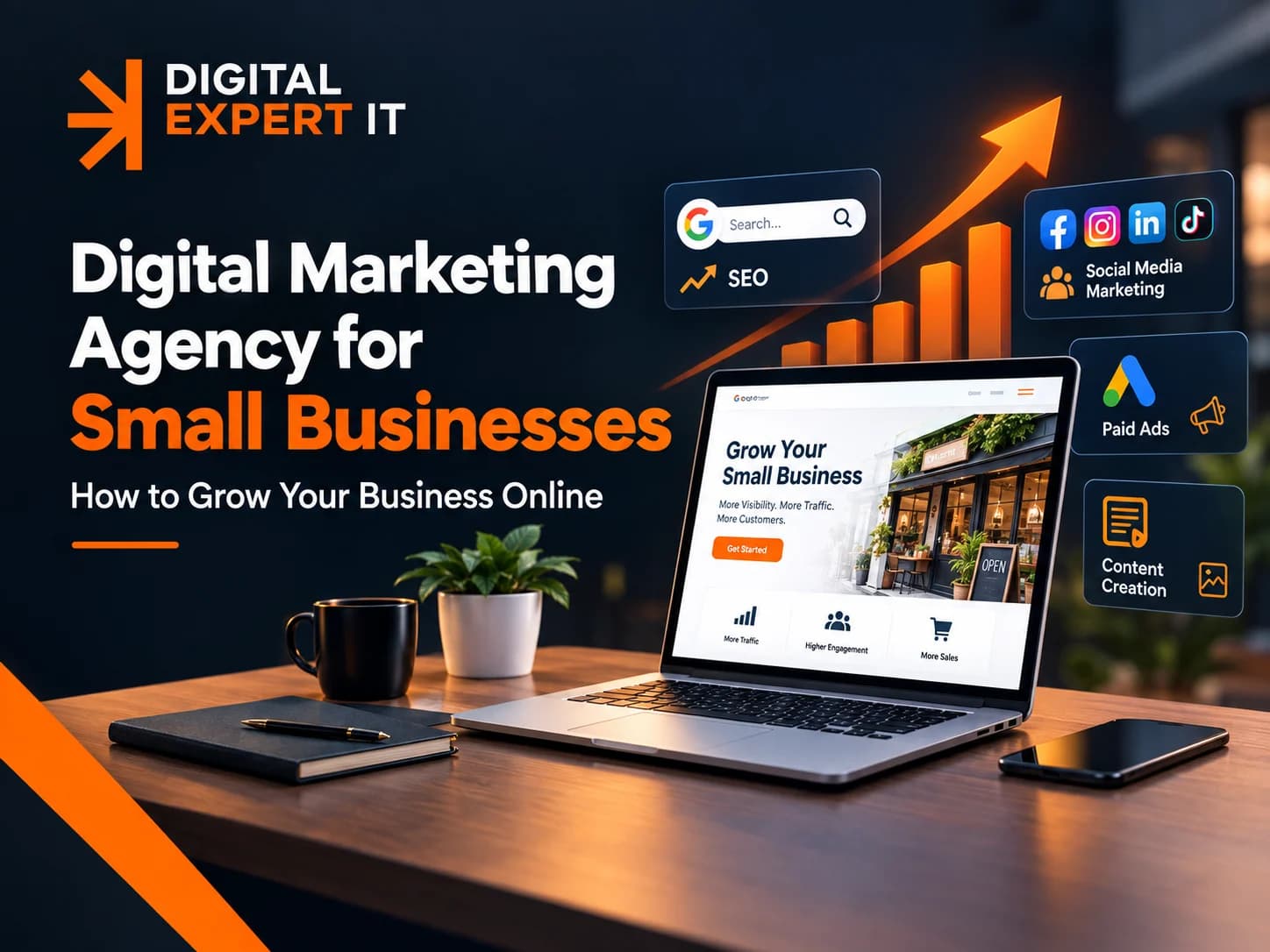 September 18, 20269 min read
Digital Marketing Agency for Small Businesses: How to Grow Your Business Online
D
Digital Expert IT
Author
Running a small business is already a full-time job. You have customers to serve, employees to manage, products or services to improve, and countless daily tasks competing for your attention. The last thing you want is to spend hours trying to figure out Google rankings, Facebook ads, website traffic, or social media algorithms.
That is where a digital marketing agency for small businesses can make a real difference.
A good agency does more than post content or run advertisements. It helps your business build a stronger online presence, reach the right audience, generate qualified leads, and turn online attention into real customers.
Why Digital Marketing Matters for Small Businesses
Today, customers often discover a business online before they ever contact it.
They may search for a service on Google, check a company's website, look at its social media pages, read reviews, or watch a video before deciding whether to buy.
If your business is difficult to find online, you may be losing potential customers to competitors who are easier to discover.
Digital marketing gives small businesses the opportunity to compete for attention without depending entirely on traditional advertising. Instead of trying to reach everyone, you can focus your marketing on people who are actually interested in what you offer.
That could mean someone searching for a local service, someone watching videos related to your industry, or someone who has already visited your website and needs a reason to come back.
What Does a Digital Marketing Agency for Small Businesses Do?
A small business digital marketing agency typically combines several strategies instead of relying on one marketing channel.
1. Search Engine Optimization
SEO helps your website become more visible when potential customers search for products or services related to your business.
For example, a local plumbing company might want to appear for searches such as "plumber near me" or "emergency plumber in [city]."
Effective SEO can involve:
- Keyword research
- On-page optimization
- Technical SEO
- Local SEO
- Website speed improvements
- Content creation
- Internal linking
- Search performance monitoring
Local businesses can also benefit from keeping their Google Business Profile complete and accurate. Google says local rankings are primarily influenced by relevance, distance, and prominence.
SEO is not about stuffing keywords into every paragraph. It is about making your website useful, understandable, and relevant to what your customers are searching for.
2. Social Media Marketing
Your customers may spend a significant amount of time on platforms such as Facebook, Instagram, LinkedIn, or YouTube.
But simply having social media accounts does not guarantee results.
A digital marketing agency can help create a consistent content strategy based on your audience and business goals. Depending on the business, that might include educational posts, product demonstrations, customer stories, short-form videos, promotional campaigns, or behind-the-scenes content.
The goal is not necessarily to go viral.
For a small business, reaching the right 500 people can be more valuable than reaching 50,000 people who will never become customers.
3. Paid Advertising
Organic marketing can take time. Paid advertising can help businesses reach targeted audiences more quickly.
Platforms such as Google Ads and Meta Ads allow businesses to target audiences based on factors such as search intent, location, interests, demographics, and previous interactions.
However, spending money on ads does not automatically create profitable campaigns.
Successful advertising requires the right combination of:
- Audience targeting
- Strong creative
- Compelling offers
- Landing pages
- Conversion tracking
- Budget management
- Continuous testing
A good agency looks beyond clicks and impressions and focuses on what happens after someone clicks.
4. Conversion-Focused Website Design
Imagine getting hundreds of visitors every month but receiving very few inquiries.
The problem may not be your traffic. It could be your website.
A modern small business website should make it easy for visitors to understand what you offer and what they should do next.
That might mean booking a consultation, requesting a quote, calling your business, purchasing a product, or submitting a contact form.
Your website should load quickly, work properly on mobile devices, communicate trust, and guide visitors toward a clear next step.
For businesses looking to combine development, SEO, performance, and conversion-focused design, Digital Expert IT provides web and digital growth solutions designed around business goals rather than aesthetics alone.
5. Content Marketing
Content gives your business an opportunity to answer questions before customers ever contact you.
A dentist could publish articles about common dental questions. A real estate professional could create neighborhood guides. An accounting firm could explain common tax questions. An online store could create buying guides.
Over time, useful content can attract search traffic, demonstrate expertise, and help potential customers become more familiar with your brand.
Google's guidance emphasizes content that is helpful, reliable, original, and created primarily for people rather than simply for search rankings.
How to Choose the Right Digital Marketing Agency
Not every agency will be the right fit for every small business.
Before hiring one, look beyond promises such as "guaranteed #1 rankings" or "instant results."
Instead, ask practical questions:
Do they understand your industry?
An agency should take time to understand your customers, competitors, goals, and challenges.
Can they explain their strategy clearly?
You should understand what they plan to do and why those activities matter.
Do they measure meaningful results?
Traffic is useful, but leads, sales, conversion rates, customer acquisition costs, and revenue may tell you much more about business performance.
Can they handle multiple parts of your online presence?
Depending on your needs, you may benefit from combining SEO, paid advertising, social media, content, website development, and conversion optimization.
You can explore Digital Expert IT's digital marketing and business growth services to see how these areas can work together as part of a broader growth strategy.
How Much Does Digital Marketing Cost for a Small Business?
There is no single price that applies to every small business.
A local service company with one location may need a different strategy from an e-commerce store selling nationally. Similarly, a new business may have different priorities from an established company that already receives thousands of website visitors.
Your budget can depend on factors such as:
- Number of marketing channels
- Advertising budget
- Competition
- Geographic target
- Website condition
- Content requirements
- SEO goals
- Campaign complexity
The important question is not simply, "How much does digital marketing cost?"
A better question is, "What marketing investment can realistically help my business generate profitable growth?"
Why a Long-Term Strategy Matters
Digital marketing rarely works as a one-time project.
A website needs ongoing improvements. SEO requires monitoring and new content. Advertising campaigns need testing. Social media requires consistency. Customer behavior changes over time.
The businesses that approach digital marketing as an ongoing growth system can make better decisions because they have data to learn from.
Instead of asking, "What should we post this week?" you can start asking better questions:
Which channel generates the most qualified leads?
Which landing page converts best?
Which content attracts potential customers?
Which advertising campaign produces profitable customers?
That shift from random marketing to measurable strategy can make digital marketing much more valuable for a small business.
Conclusion
Choosing a digital marketing agency for small businesses is not simply about finding someone who can manage Facebook or improve your Google rankings.
The right strategy connects different parts of your online presence: SEO brings relevant visitors, content builds trust, social media keeps your brand visible, advertising creates targeted opportunities, and a conversion-focused website turns attention into action.
For small businesses, the goal should not be to be everywhere.
The goal should be to be visible in the places where your potential customers are already looking—and give them a clear reason to choose you.
With the right strategy, digital marketing can become more than another business expense. It can become a practical system for generating visibility, leads, customers, and long-term growth.
FAQs About Digital Marketing for Small Businesses
1. What is a digital marketing agency for small businesses?
A digital marketing agency for small businesses helps companies attract and convert customers through online channels such as SEO, Google Ads, social media marketing, content marketing, website optimization, and conversion tracking.
2. Is digital marketing worth it for a small business?
It can be, especially when marketing activities are connected to measurable business goals. The value depends on factors such as your industry, audience, competition, offer, budget, and execution.
3. How can a small business get more customers online?
A small business can combine local SEO, useful content, social media, paid advertising, and a conversion-focused website. The best combination depends on where its target customers spend time and how they search for products or services.
4. How much should a small business spend on digital marketing?
There is no universal budget. Businesses should consider their revenue, customer acquisition economics, competition, growth goals, and the marketing channels most relevant to their audience.
5. How long does SEO take for a small business?
SEO results can vary significantly depending on competition, website authority, technical condition, content quality, location, and the search terms being targeted. SEO is generally a long-term strategy rather than an overnight solution.
6. Should a small business hire an agency or do digital marketing in-house?
It depends on the company's budget, available expertise, and internal resources. An agency can provide access to specialized skills and systems without requiring a business to build an entire marketing team internally.
7. What digital marketing services should a small business start with?
Many businesses start with a strong website, local or organic SEO, and a focused social media or paid advertising strategy. The right starting point depends on the business model, target audience, and immediate growth objectives.
8. Can digital marketing help a local business?
Yes. Local SEO, Google Business Profile optimization, location-focused content, reviews, social media, and targeted advertising can all help local businesses become more discoverable to potential customers. Google notes that local search visibility is influenced by relevance, distance, and prominence.