49/08, Nirala Residential Area, Khulna
contact@digitalexpertit.com
←Back to Articles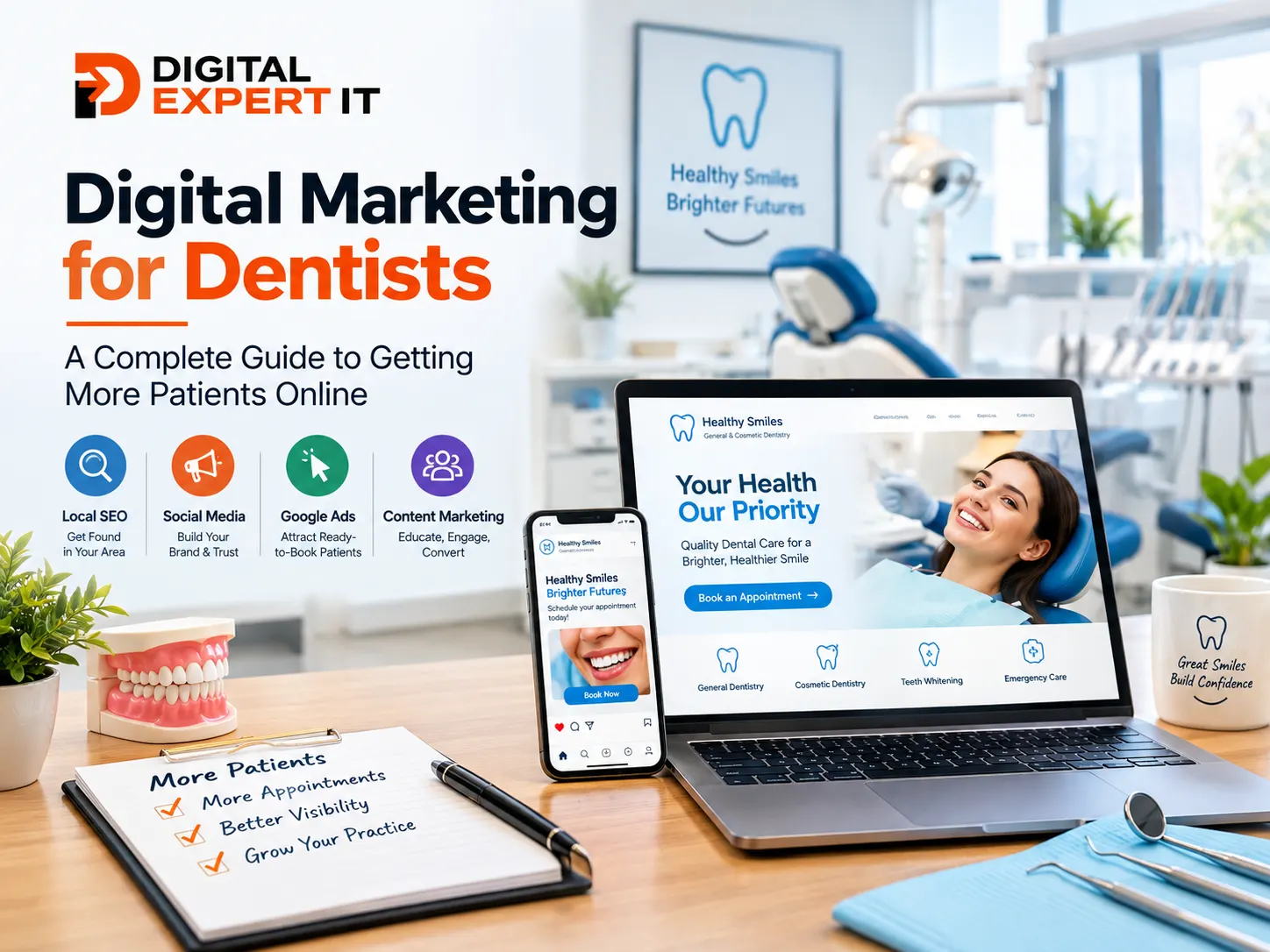 September 26, 202610 min read
Digital Marketing for Dentists: A Complete Guide to Getting More Patients Online
D
Digital Expert IT
Author
Running a dental practice is no longer just about providing excellent treatment. Patients today often search online before they ever call a dental office. They compare dentists, read reviews, check websites, look at services, and decide which practice feels trustworthy enough to book an appointment with.
That is why digital marketing for dentists has become an important part of growing a modern dental practice.
The good news is that dental marketing does not have to mean posting randomly on social media or spending money on ads without knowing what is working. With the right strategy, dentists can use search engines, websites, social media, paid advertising, and useful content to attract people who are already looking for dental services.
What Is Digital Marketing for Dentists?
Digital marketing for dentists is the use of online marketing channels to attract new patients, build trust, increase visibility, and encourage people to book appointments.
A complete dental marketing strategy can include:
- Search engine optimization (SEO)
- Local SEO
- Google Business Profile optimization
- Google Ads
- Social media marketing
- Dental website optimization
- Content marketing
- Online reputation and review management
- Conversion tracking and analytics
The goal is not simply to generate website traffic. The real goal is to turn online visibility into qualified patient inquiries and booked appointments.
Google's current guidance emphasizes useful, reliable, people-first content and a good overall page experience rather than simply producing content around keywords.
Why Do Dentists Need Digital Marketing?
Think about how someone chooses a dentist today.
A person may search for “dentist near me,” “emergency dentist,” “cosmetic dentist,” or “teeth whitening near me.” They may then look at several practices before making a decision.
If your dental practice does not appear when potential patients are searching, another practice gets that opportunity.
Digital marketing helps dentists become visible at different stages of the patient's decision-making process.
For example, someone searching for information about dental implants may discover an educational blog post. Later, they may see the practice on Google, visit the website, read patient reviews, and finally contact the office.
A strong digital presence keeps your practice visible throughout that journey.
1. Invest in Local SEO for Your Dental Practice
For most dental practices, local visibility is extremely important.
Patients usually want a dentist who is convenient to reach, so searches often include phrases such as:
- Dentist near me
- Dentist in [city]
- Family dentist in [city]
- Emergency dentist in [city]
- Cosmetic dentist in [city]
- Dental implants in [city]
Your Google Business Profile should contain accurate business information, opening hours, services, photos, and other useful details. Your website should also clearly communicate the areas and services you serve.
Local SEO is not about repeating your city name dozens of times. It is about making it easy for both patients and search engines to understand who you serve and what your practice offers.
2. Build a Dental Website That Converts Visitors
A beautiful website is useful, but a dental website also needs to make taking the next step easy.
When someone lands on your website, they should quickly understand:
Who are you? What services do you provide? Where are you located? Why should I trust you? How can I book?
Important elements can include:
- Clear service pages
- Simple appointment calls-to-action
- Mobile-friendly design
- Fast page loading
- Dentist and team information
- Patient reviews
- Frequently asked questions
- Clear contact information
- High-quality images
- Easy-to-use appointment forms
Your website should work as more than an online brochure. It should act as a patient acquisition tool.
If you are looking for a team that combines website development, SEO, performance optimization, and digital marketing, explore Digital Expert IT's digital marketing and web solutions.
3. Use Dental SEO to Capture Long-Term Search Traffic
SEO can help your practice appear when people search for dental services and questions related to oral health.
Instead of creating one generic “Dental Services” page, consider creating useful, focused pages around the services you actually provide.
For example:
- Dental implants
- Teeth whitening
- Invisalign
- Emergency dentistry
- Pediatric dentistry
- Root canal treatment
- Cosmetic dentistry
- Dental crowns
You can also create helpful articles answering common patient questions.
For example:
“How Long Does a Dental Implant Take to Heal?”
or
“What Should You Do During a Dental Emergency?”
This type of content can attract people earlier in the decision-making process and help establish your practice as a useful source of information.
4. Use Google Ads to Reach Patients Faster
SEO can take time. Paid search advertising can help dental practices reach potential patients while they are actively searching.
For example, a dentist could create campaigns targeting searches related to emergency dental treatment, implants, cosmetic dentistry, or other high-intent services.
However, simply running Google Ads is not enough.
Your campaign needs:
- Relevant keywords
- Strong ad copy
- Targeted locations
- Dedicated landing pages
- Clear calls-to-action
- Conversion tracking
- Ongoing optimization
The important metric is not simply how many clicks an advertisement receives. You want to understand whether those clicks turn into calls, inquiries, and appointments.
5. Build Trust With Reviews and Social Proof
Choosing a dentist is a personal decision. Trust matters.
Online reviews can influence whether someone decides to contact your practice, particularly when they are comparing several local options.
Encourage genuine patients to leave honest feedback where appropriate, and respond professionally to reviews without revealing private patient information.
Your website can also showcase appropriate testimonials, team photos, before-and-after examples where permitted, educational videos, and other trust-building content.
The objective is simple: help a potential patient feel more comfortable taking the next step.
6. Use Social Media to Humanize Your Dental Practice
Social media does not have to be a constant stream of promotional posts.
Dental practices can use platforms such as Facebook and Instagram to show the human side of the business.
Content ideas include:
- Dental care tips
- Common dental myths
- Team introductions
- Behind-the-scenes content
- Frequently asked patient questions
- Treatment explanations
- Office tours
- Educational short videos
- Seasonal dental reminders
Short-form video can be particularly useful because it allows dentists to explain complicated topics in a simple and approachable way.
The objective is not to make every post sell something. Consistent educational content can help people remember your practice when they eventually need treatment.
7. Track What Actually Produces Patients
One of the biggest mistakes in digital marketing for dentists is measuring activity instead of results.
Website visitors, likes, impressions, and clicks can be useful, but they do not tell the complete story.
Dental practices should ideally track actions such as:
- Phone calls
- Appointment form submissions
- Online bookings
- Contact requests
- Campaign conversions
- Cost per lead
- Cost per acquired patient
This information helps you understand which marketing activities deserve more attention and which ones need improvement.
Common Digital Marketing Mistakes Dentists Should Avoid
Several mistakes can make dental marketing less effective.
Ignoring local SEO: A practice can have a beautiful website but still struggle to appear in local searches.
Using a slow website: Patients may leave before they even see your services.
Posting without a strategy: Random social media content rarely creates a predictable growth system.
Running ads without tracking: Without conversion tracking, it is difficult to understand whether advertising is producing real business results.
Creating generic content: Dental content should answer real patient questions rather than simply repeat keywords.
Ignoring mobile users: Many prospective patients discover businesses from smartphones, so the mobile experience matters.
How to Create a Dental Marketing Strategy That Works
A practical approach is to build your marketing around the patient journey.
First, identify the dental services you want to grow.
Next, research what potential patients are searching for and create dedicated service pages around those needs.
Then improve your local SEO and Google Business Profile so nearby patients can discover your practice.
After that, use Google Ads or social media advertising where paid acquisition makes sense.
Finally, track calls, forms, bookings, and other meaningful conversions so you can continuously improve the strategy.
Digital marketing works best as a connected system rather than a collection of unrelated tactics.
Final Thoughts
Digital marketing for dentists is ultimately about making it easier for the right patients to find, trust, and contact your practice.
A strong strategy combines local SEO, a conversion-focused website, useful content, online reviews, paid advertising, social media, and reliable conversion tracking.
You do not need to do everything at once. Start with the fundamentals, understand your audience, measure what matters, and improve consistently.
If your dental practice needs help with digital marketing, SEO, conversion-focused websites, advertising, and web solutions, Digital Expert IT can help build a strategy around your business goals rather than relying on disconnected marketing activities.
FAQs About Digital Marketing for Dentists
1. What is digital marketing for dentists?
Digital marketing for dentists is the use of online channels such as SEO, local search, Google Ads, websites, social media, content marketing, and online reviews to attract and convert potential dental patients.
2. How can dentists get more patients online?
Dentists can attract more patients by improving local SEO, optimizing their Google Business Profile, building a conversion-focused website, creating useful dental content, collecting genuine reviews, and using targeted advertising campaigns.
3. Is SEO important for dental practices?
Yes. Dental SEO can help practices become more visible when potential patients search for dental services in their area. A strong SEO strategy can also generate relevant organic traffic over time.
4. How does local SEO help dentists?
Local SEO helps dental practices appear for location-based searches such as “dentist near me” or “dentist in [city].” Accurate business information, relevant website content, local visibility, and genuine reviews can all contribute to a stronger local presence.
5. Should dentists use Google Ads?
Google Ads can be useful when a dental practice wants to reach people who are actively searching for specific services. Campaigns should be targeted carefully and connected to conversion tracking so the practice can measure meaningful results.
6. What should a dental website include?
A dental website should clearly explain the practice's services, location, team, contact information, appointment options, and reasons patients can trust the practice. It should also be fast, mobile-friendly, easy to navigate, and designed around clear patient actions.
7. How much does digital marketing for dentists cost?
The cost varies depending on the practice's location, competition, services, advertising budget, website requirements, and marketing goals. Instead of choosing a package based only on price, practices should consider what needs to be accomplished and how results will be measured.
8. How long does dental SEO take to work?
SEO is generally a long-term strategy rather than an instant solution. The timeline can vary depending on competition, website quality, location, existing authority, technical SEO, content quality, and the consistency of optimization.
9. Can social media help a dental practice grow?
Yes. Social media can help dentists educate potential patients, demonstrate expertise, introduce their team, build familiarity, and stay connected with their local audience. It works best when social content supports a broader marketing strategy.
10. What is the most important goal of dental marketing?
The ultimate goal should be to connect marketing activity with real business outcomes—such as qualified inquiries, appointment bookings, and new patients—while providing useful information and a trustworthy experience throughout the patient's journey.