49/08, Nirala Residential Area, Khulna
contact@digitalexpertit.com
←Back to Articles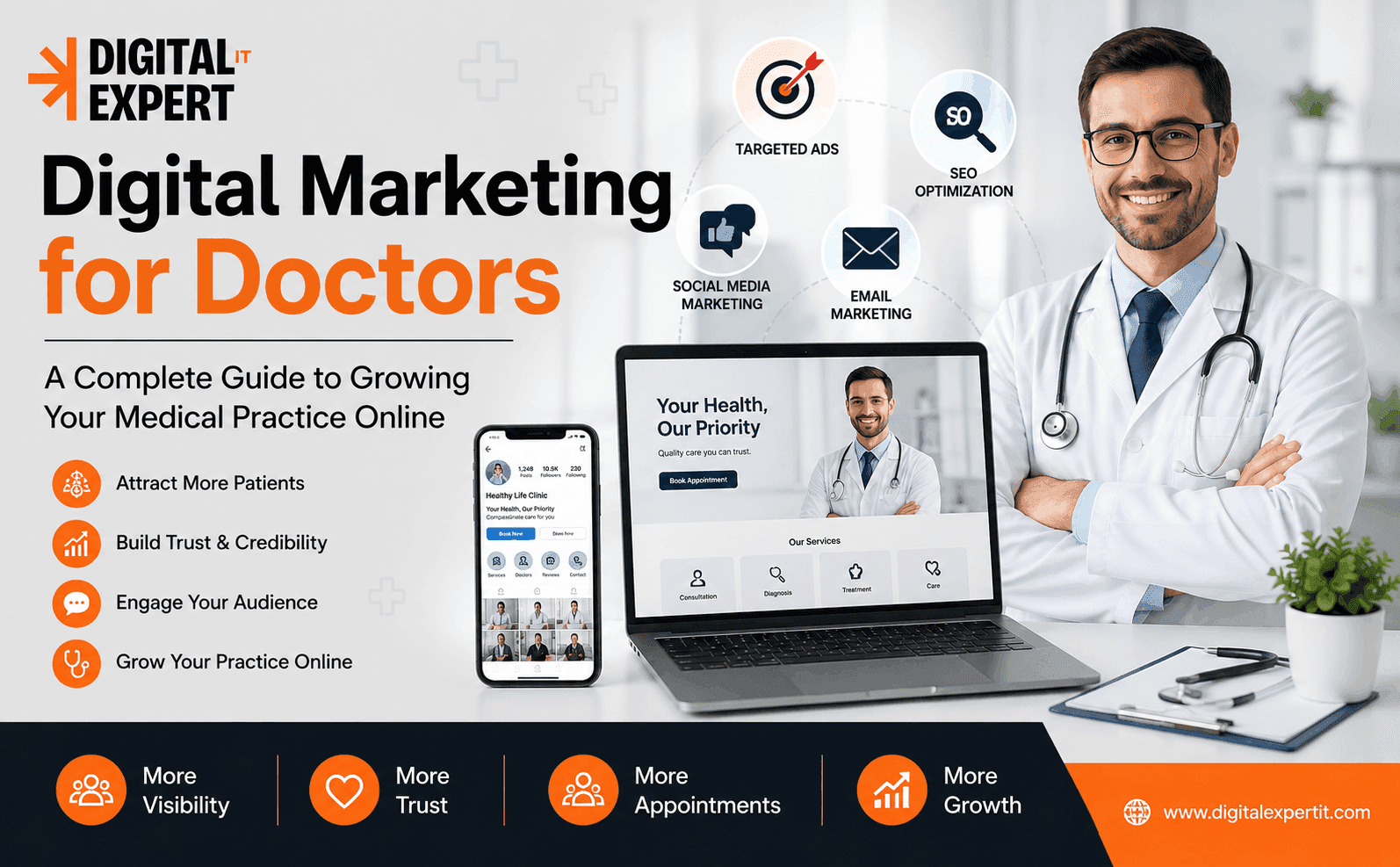 September 4, 20269 min read
Digital Marketing for Doctors: A Complete Guide to Growing Your Medical Practice Online
D
Digital Expert IT
Author
Patients no longer rely only on referrals, newspaper ads, or signs outside a clinic when choosing a doctor. Today, the journey often starts with a simple Google search. Someone may search for “doctor near me,” “best dermatologist in [city],” or “pediatrician accepting new patients” before they ever pick up the phone.
That is why digital marketing for doctors has become an important part of growing a modern medical practice.
A strong online presence can help doctors become more visible, build patient trust, and turn online searches into real appointments. But medical marketing is different from promoting a regular business. Patients are making decisions about their health, so credibility, accuracy, privacy, and professionalism matter at every stage.
In this guide, we’ll look at the most effective digital marketing strategies doctors and medical practices can use to attract more patients and build a trustworthy online brand.
Why Digital Marketing Matters for Doctors
Think about the last time you needed a new service. You probably searched online, checked reviews, visited a website, and compared your options before making a decision.
Patients do the same thing when looking for healthcare providers.
A professional digital presence allows your practice to appear when potential patients are actively searching for the services you provide. It also gives them an opportunity to learn about your expertise, services, location, appointment process, and experience before contacting you.
The goal isn't simply to get more website visitors. The real goal is to attract the right patients and make it easy for them to take the next step.
A successful strategy can combine medical SEO, Google Business Profile optimization, content marketing, social media, online reputation management, paid advertising, and conversion-focused website design.
1. Build a Professional Medical Website
Your website is often the first impression a potential patient has of your practice.
A modern doctor's website should be clean, fast, mobile-friendly, and easy to navigate. Patients should quickly find important information such as:
- Medical services and specialties
- Doctor credentials and experience
- Clinic location and opening hours
- Insurance information
- Contact details
- Appointment options
- Frequently asked questions
- Educational healthcare content
Your website should also have clear calls to action. Instead of making visitors search for how to contact you, provide visible options such as “Book an Appointment,” “Call Now,” or “Contact Our Practice.”
A well-designed website is not just an online brochure. It can become one of your practice's most valuable patient acquisition tools.
2. Invest in SEO for Doctors
Medical SEO helps your practice appear in search results when potential patients are looking for healthcare services.
For example, a cardiologist may want to target searches such as:
- Cardiologist near me
- Heart specialist in [city]
- Best cardiologist for heart problems
- Cardiology consultation
- Heart health specialist
Instead of trying to rank for every possible keyword, your SEO strategy should focus on relevant searches connected to your specialty, services, and location.
Local SEO is especially important for doctors because many patients prefer providers who are conveniently located.
Creating dedicated service pages, optimizing location information, improving website performance, publishing useful healthcare content, and maintaining consistent business information can all strengthen your search visibility.
If you want to build a stronger online presence through professional SEO and digital marketing services, working with a team that understands both search strategy and business goals can make the process more structured.
3. Optimize Your Google Business Profile
When someone searches for a doctor nearby, Google often displays local business information before traditional organic results.
Your Google Business Profile can therefore play a major role in local patient acquisition.
Make sure your profile contains accurate information about your:
- Practice name
- Address
- Phone number
- Website
- Business hours
- Services
- Categories
- Photos
Regularly updating your profile can also help keep potential patients informed.
Most importantly, encourage genuine patients to leave honest reviews. Reviews can influence how people perceive your practice before they visit your website or make an appointment.
Never manufacture reviews or make misleading claims. Healthcare marketing depends heavily on trust, and protecting that trust should always come first.
4. Create Helpful Medical Content
Content marketing can help doctors demonstrate expertise while answering the questions patients are already asking.
You don't need to write complicated medical textbooks. Focus on clear, useful topics that your patients genuinely care about.
For example, a dermatologist could publish:
- What causes adult acne?
- When should you see a dermatologist?
- How often should you have a skin check?
- Common signs of skin conditions
- How to protect your skin from sun damage
A dentist could create content about:
- How often should you visit the dentist?
- What causes sensitive teeth?
- Signs you may need a root canal
- How to prevent cavities
This type of content can bring qualified search traffic while helping potential patients become more familiar with your expertise.
For healthcare content, accuracy is particularly important. Articles should be professionally written, factually responsible, and reviewed or supported by qualified medical professionals where appropriate.
5. Use Social Media to Build Patient Trust
Social media isn't only for entertainment. For doctors, it can be a useful way to humanize a practice and educate potential patients.
Platforms such as Facebook and Instagram can be used to share:
- Health education tips
- Frequently asked questions
- Short educational videos
- Practice updates
- General wellness information
- Doctor introductions
- Behind-the-scenes content
- Community involvement
Short-form video can be especially effective because it allows doctors to explain complicated subjects in a simple, approachable way.
The key is consistency. You don't need to post several times every day. A realistic content schedule with useful information is usually better than posting frequently without a clear purpose.
6. Consider Google Ads for Faster Visibility
SEO is a long-term strategy, but paid advertising can provide faster visibility for specific services.
For example, a medical practice opening a new location may use Google Ads to target people searching for relevant services in that geographic area.
A campaign might focus on keywords related to:
- Specific treatments
- Medical specialties
- Consultations
- Local healthcare services
- Appointment-related searches
However, healthcare advertising comes with additional restrictions and regulations. Google also has specific policies for healthcare and medicine advertising.
Therefore, campaigns should be planned carefully and reviewed against applicable advertising requirements and local regulations.
7. Manage Your Online Reputation
Before booking an appointment, many patients look at reviews.
Your online reputation can therefore influence whether someone chooses your practice or keeps searching.
Reputation management should include monitoring reviews, responding professionally, and encouraging genuine feedback from patients.
When responding publicly, protect patient privacy. Avoid revealing information that could identify someone as a patient or disclose details about their treatment.
A professional response can show prospective patients that your practice values communication and patient experience.
8. Track What Actually Produces Results
One of the biggest advantages of digital marketing is measurability.
Instead of simply asking, “Is marketing working?” you can track meaningful indicators such as:
- Website traffic
- Organic search visibility
- Phone calls
- Appointment requests
- Contact form submissions
- Google Business Profile interactions
- Ad conversions
- Cost per lead
- Most visited service pages
This information helps identify which marketing activities are generating real business results.
The focus should always be on qualified patient inquiries and appointments, not vanity metrics such as traffic alone.
Choosing the Right Digital Marketing Strategy for Your Practice
There isn't one marketing strategy that works equally well for every doctor.
A local family physician may need a strong local SEO strategy, while a cosmetic surgeon may benefit from a combination of SEO, educational video content, social media, and paid advertising.
Start with the fundamentals: a professional website, local search visibility, useful content, reputation management, and clear conversion paths. Then expand into additional channels based on your goals and budget.
For practices looking for a complete online growth strategy, Digital Expert IT provides digital solutions designed to help businesses strengthen their online presence and generate measurable growth.
Conclusion
Digital marketing for doctors is no longer simply about having a website or posting occasionally on social media. It is about creating a trustworthy digital experience that helps patients discover your practice, understand your services, and confidently take the next step.
From medical SEO and Google Business Profile optimization to content marketing, social media, paid advertising, and reputation management, every channel should work toward the same objective: connecting the right patients with your practice.
The most successful healthcare marketing strategies don't try to make a doctor look like a salesperson. They make expertise easier to discover, information easier to understand, and appointments easier to book.
FAQs About Digital Marketing for Doctors
1. What is digital marketing for doctors?
Digital marketing for doctors is the use of online channels such as SEO, websites, Google Business Profiles, social media, content marketing, and paid advertising to increase a medical practice's visibility and attract potential patients.
2. What is the best digital marketing strategy for doctors?
There is no single best strategy for every practice. A strong foundation usually includes a professional website, local SEO, Google Business Profile optimization, useful medical content, reputation management, and a clear appointment conversion process.
3. How does SEO help doctors get more patients?
SEO helps medical practices appear when potential patients search for relevant healthcare services online. Local SEO can be particularly valuable because patients often search for doctors and specialists in specific locations.
4. Should doctors use social media marketing?
Yes. Social media can help doctors educate their audience, demonstrate expertise, answer common questions, and build familiarity with their practice. Educational posts and short videos can be effective formats.
5. How long does medical SEO take to produce results?
SEO usually takes time because rankings depend on factors such as competition, website quality, authority, content, and location. A consistent strategy can gradually improve visibility, but doctors should avoid agencies that guarantee a specific Google ranking or a fixed number of patients.
6. Can doctors use Google Ads?
Doctors and medical practices can use Google Ads in many circumstances, but healthcare advertising is subject to Google's policies as well as applicable laws and professional regulations. Campaigns should be created carefully to avoid policy or compliance issues.
7. How much does digital marketing for doctors cost?
The cost depends on the specialty, location, competition, services required, advertising budget, and marketing goals. A small local practice may need a different investment than a multi-location medical organization.
8. Why are online reviews important for doctors?
Reviews help prospective patients understand other people's experiences with a practice. Genuine, consistent reviews can strengthen credibility and influence a patient's decision when comparing healthcare providers.