49/08, Nirala Residential Area, Khulna
contact@digitalexpertit.com
←Back to Articles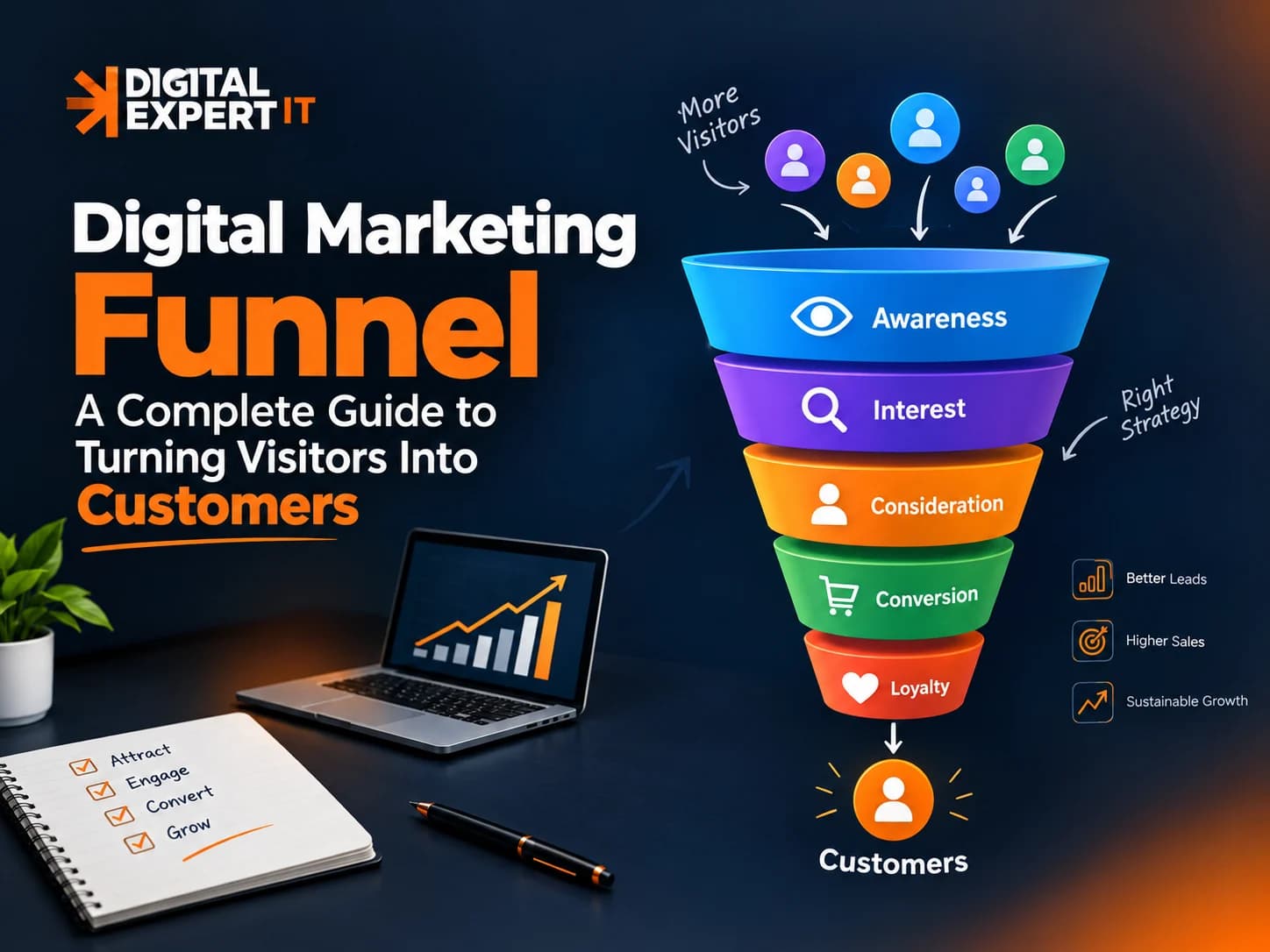 September 15, 20269 min read
Digital Marketing Funnel: A Complete Guide to Turning Visitors Into Customers
D
Digital Expert IT
Author
Getting people to visit your website is only the beginning. The bigger challenge is turning those visitors into leads, customers, and eventually loyal customers.
This is where a digital marketing funnel becomes important.
A digital marketing funnel is a structured journey that guides potential customers from their first interaction with a business to a purchase and, ideally, repeat business. Instead of showing the same message to everyone, a funnel matches your content, advertising, and offers with the customer's level of interest and buying intent.
For businesses investing in SEO, social media, Google Ads, Facebook Ads, or content marketing, understanding the funnel can make marketing much more organized and measurable.
What Is a Digital Marketing Funnel?
A digital marketing funnel is a framework that represents the different stages a potential customer moves through before becoming a customer.
Think about your own buying behavior. You probably don't see a company for the first time and immediately purchase from it. You may discover the brand through Google or social media, visit its website, read some content, compare alternatives, check reviews, and then decide whether to contact or buy from the business.
That entire journey can be viewed as a funnel.
The exact number of stages varies between marketing models, but the most useful approach for many businesses is to think about four core stages:
- Awareness
- Consideration
- Conversion
- Retention
Each stage has a different purpose and requires a different marketing approach.
Why Does a Digital Marketing Funnel Matter?
Many businesses invest in marketing without creating a clear path between attracting someone and converting them.
For example, a company might publish social media posts, run Google Ads, and write blogs—but if those activities aren't connected, visitors may not know what to do next.
A funnel helps connect those activities.
It can help businesses:
- Attract the right audience
- Build trust before asking for a sale
- Generate qualified leads
- Improve website conversions
- Reduce wasted advertising spend
- Understand where potential customers drop off
- Create better customer experiences
- Instead of thinking only about getting more traffic, businesses can focus on what happens after the traffic arrives.
The 4 Main Stages of a Digital Marketing Funnel
1. Awareness: Get Discovered
Awareness is the top of the funnel.
At this stage, people may not know your business yet. They may simply be searching for information, trying to understand a problem, or discovering possible solutions.
Your goal isn't necessarily to make an immediate sale. It's to get noticed and provide something useful.
Common awareness strategies include:
- SEO blog posts
- Social media content
- YouTube videos
- Educational guides
- Short-form videos
- Informational Google searches
- Brand awareness campaigns
For example, a web development company could publish an article about “How Much Does a Business Website Cost?” Someone searching for that information may discover the company for the first time.
At this point, helpful information is usually more effective than an aggressive sales pitch.
2. Consideration: Build Trust
Once someone knows about your business, the next question is usually:
“Can this company actually solve my problem?”
This is the consideration stage.
Potential customers may compare providers, read reviews, explore your website, watch videos, examine case studies, or look at your previous work.
This is where businesses need to demonstrate expertise and credibility.
Useful consideration-stage content includes:
- Case studies
- Customer testimonials
- Comparison guides
- Detailed service pages
- Product demonstrations
- Educational videos
- FAQs
- Email campaigns
- Retargeting advertisements
For example, someone who discovered a digital marketing agency through a blog post may later visit its service pages, review case studies, and compare the agency with competitors.
Your job at this stage is to reduce uncertainty and answer the questions preventing the customer from taking the next step.
3. Conversion: Turn Interest Into Action
The conversion stage is where interest becomes action.
The action doesn't always have to be a purchase. Depending on the business, a conversion could be:
- Filling out a contact form
- Booking a consultation
- Requesting a quote
- Starting a free trial
- Calling the business
- Purchasing a product
- Signing up for an email list
Your website plays a major role here.
A strong conversion page should make the next step obvious. It should communicate the value of the offer, provide relevant proof, answer important objections, and make the process simple.
For example, if you're running Google Ads for a local service business, sending every visitor to a generic homepage may create unnecessary friction. A dedicated landing page focused on that specific service can provide a clearer path toward conversion.
Conversion tracking is also essential because you need to know which campaigns and channels are actually generating meaningful results.
4. Retention: Keep Customers Coming Back
The funnel doesn't have to end after the first purchase.
Existing customers can become repeat buyers, long-term clients, reviewers, and referral sources.
Retention strategies can include:
- Email follow-ups
- Customer support
- Loyalty programs
- Personalized offers
- Educational content
- Product recommendations
- Client check-ins
- Referral campaigns
Retention is especially important for businesses that rely on repeat purchases or recurring services.
A customer who has already trusted your business generally doesn't need the same introduction as a completely new prospect. Your communication can become more personalized and focused on delivering ongoing value.
How to Build a Digital Marketing Funnel
Creating a funnel doesn't have to be complicated. Start with the customer journey.
Step 1: Define Your Target Customer
Understand who you're trying to reach.
Identify their problems, goals, questions, buying concerns, and preferred platforms.
Step 2: Map the Customer Journey
Write down what happens from the first interaction to conversion.
For example:
Google search → Blog post → Service page → Case study → Consultation → Customer
This simple exercise can reveal gaps in your marketing process.
Step 3: Create Content for Each Stage
Don't rely on one type of content.
Use educational content for awareness, proof and detailed information for consideration, strong offers for conversion, and valuable follow-up content for retention.
Step 4: Connect Your Channels
SEO, social media, paid advertising, email, and your website shouldn't operate as completely separate systems.
A person might discover you through Instagram, visit your website later through Google, and finally convert after seeing a retargeting advertisement.
A connected strategy makes these interactions work together.
Step 5: Track the Right Metrics
Different funnel stages require different measurements.
For awareness, monitor metrics such as impressions, reach, organic traffic, and engagement.
For consideration, look at metrics such as page engagement, returning visitors, click-through rates, and leads.
For conversion, focus on leads, sales, conversion rate, cost per acquisition, and revenue.
For retention, monitor repeat purchases, customer lifetime value, retention rate, and referrals.
The goal isn't to collect as many numbers as possible. It's to identify where the customer journey is working and where people are dropping out.
Common Digital Marketing Funnel Mistakes
One of the most common mistakes is expecting every visitor to purchase immediately.
Other problems include:
- Using the same message for every audience
- Sending all advertising traffic to the homepage
- Ignoring retargeting
- Creating content without a clear next step
- Not tracking conversions properly
- Focusing only on traffic instead of business outcomes
- Making landing pages difficult to navigate
- Ignoring existing customers
A funnel should feel like a natural customer journey—not a series of disconnected marketing campaigns.
Final Thoughts
A well-planned digital marketing funnel gives your marketing a clear direction.
Instead of simply asking, “How can we get more visitors?” you can ask better questions:
Who are we attracting? What do they need next? Why should they trust us? What is stopping them from converting? And how can we keep them engaged afterward?
That shift can make your marketing more strategic and measurable.
Whether you're building an SEO strategy, running paid ads, growing social media, or improving your website, every channel can play a role in moving potential customers toward the next stage.
Businesses looking to build a connected growth strategy can explore Digital Expert IT's digital marketing solutions or learn more about Digital Expert IT and its approach to digital growth.
The key isn't simply having more marketing channels. It's making those channels work together as one customer journey.
FAQs About Digital Marketing Funnel
What is a digital marketing funnel?
A digital marketing funnel is a framework that maps the customer journey from discovering a business to considering its products or services, taking a desired action, and potentially becoming a repeat customer.
What are the main stages of a digital marketing funnel?
The commonly used stages are awareness, consideration, conversion, and retention. Some businesses use additional stages such as interest, discovery, decision, or advocacy depending on their marketing model.
Why is a digital marketing funnel important?
A digital marketing funnel helps businesses understand how potential customers move through the buying journey. It can also help identify weak points, improve conversions, and make marketing activities easier to measure.
How do I create a digital marketing funnel?
Start by defining your target audience and mapping their journey from first contact to conversion. Then create content and offers for each stage, connect your marketing channels, and track the metrics that matter at every step.
What is the difference between a marketing funnel and a sales funnel?
A marketing funnel generally covers the broader journey from awareness and interest through conversion and retention. A sales funnel often focuses more specifically on moving qualified prospects toward a purchase or closed deal.
What content works at the top of a digital marketing funnel?
Educational blog posts, social media content, videos, guides, infographics, and informational resources are commonly used at the awareness stage because they can introduce a problem, answer questions, and attract people who are researching solutions.
How can I improve my digital marketing funnel?
Start by finding where potential customers are dropping off. Then improve the relevant stage—for example, better educational content at the awareness stage, stronger proof during consideration, clearer calls to action during conversion, or better follow-up after purchase.
Can small businesses use a digital marketing funnel?
Yes. A funnel doesn't need to be complicated or expensive. A small business could start with SEO or social media content, a useful landing page, a clear offer, conversion tracking, and a simple follow-up process.