49/08, Nirala Residential Area, Khulna
contact@digitalexpertit.com
←Back to Articles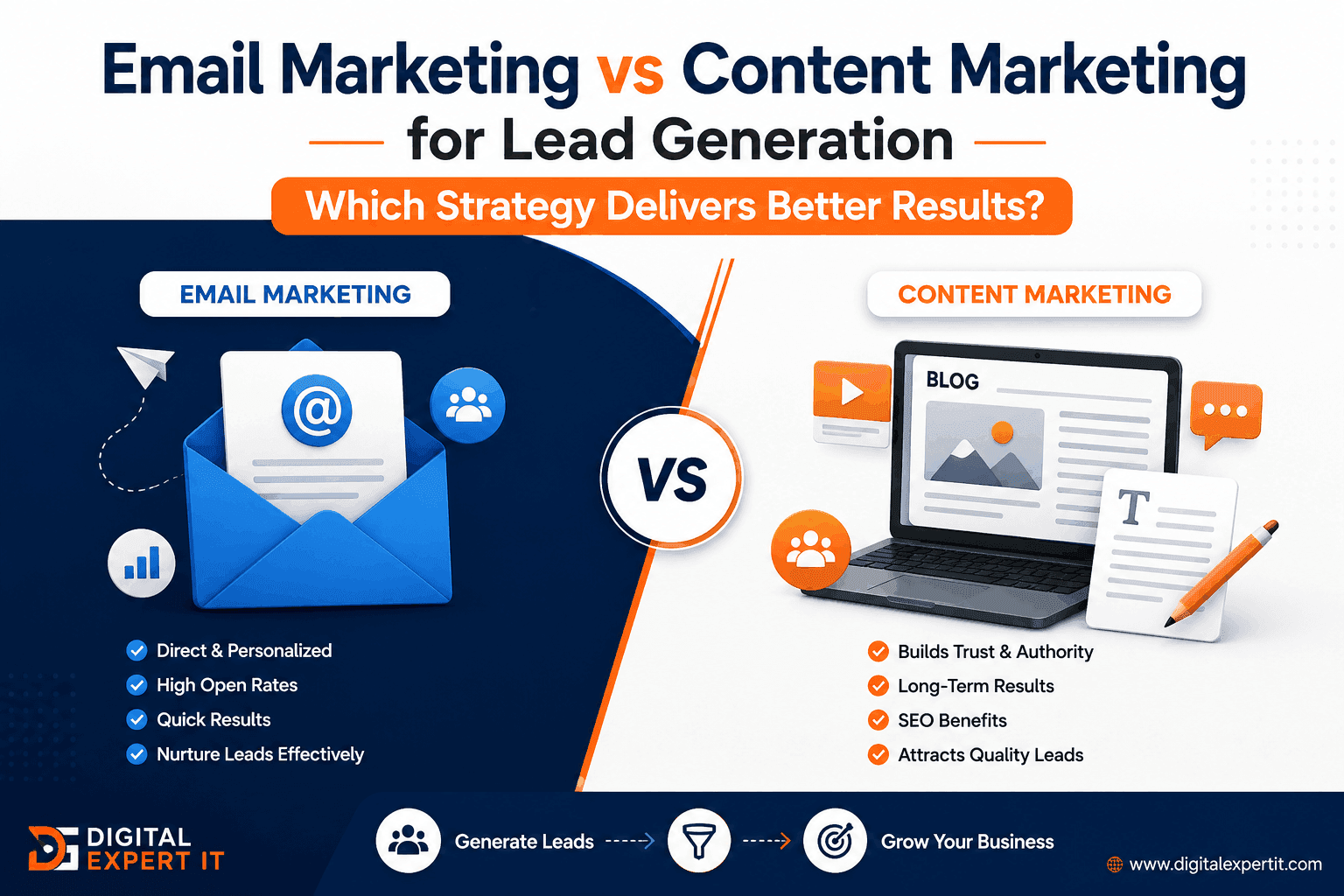 July 27, 20267 min read
Email Marketing vs Content Marketing for Lead Generation: Which Strategy Delivers Better Results?
D
Digital Expert IT
Author
In today's competitive digital landscape, attracting high-quality leads is one of the biggest challenges businesses face. Whether you're a startup, an eCommerce store, or a service-based company, generating consistent leads is the foundation of sustainable growth.
Among the many digital marketing strategies available, two of the most powerful are email marketing and content marketing. Both help businesses connect with potential customers, build trust, and increase conversions. But when it comes to lead generation, which one is more effective?
The truth is that both strategies have unique strengths. Understanding how they differ—and how they can work together—can help you create a marketing strategy that consistently brings in qualified leads.
What Is Email Marketing?
Email marketing is the practice of sending targeted emails to subscribers with the goal of nurturing relationships, promoting products or services, and encouraging specific actions.
Unlike social media, where algorithms control visibility, email gives businesses direct access to their audience's inbox. This makes it one of the highest-ROI marketing channels available.
Common email marketing campaigns include:
- Welcome emails
- Promotional offers
- Educational newsletters
- Product announcements
- Follow-up sequences
- Abandoned cart reminders
- Lead nurturing campaigns
A successful email strategy focuses on delivering value instead of constantly selling.
What Is Content Marketing?
Content marketing is the process of creating valuable, educational, and engaging content that attracts potential customers organically.
Instead of directly promoting products, content marketing helps people solve problems and answer questions. As trust grows, visitors become leads and eventually paying customers.
Examples include:
- Blog articles
- Case studies
- Videos
- Infographics
- Podcasts
- EBooks
- Guides
- Social media content
Businesses that consistently publish high-quality content often build long-term authority within their industry.
Email Marketing vs Content Marketing: The Core Difference
Although these strategies often complement each other, their primary purposes are different.
|
Email Marketing |
Content Marketing |
|
Communicates directly with existing subscribers |
Attracts new audiences organically |
|
Delivers personalized messages |
Educates and informs |
|
Produces faster conversions |
Builds long-term trust |
|
Requires an email list |
Requires consistent content creation |
|
Excellent for nurturing leads |
Excellent for generating awareness |
Think of content marketing as bringing visitors into your business, while email marketing helps convert those visitors into loyal customers.
Which Strategy Generates More Leads?
The answer depends on where your prospects are in the customer journey.
Content Marketing Wins at Attracting New Leads
People usually begin with a Google search when they have a question or problem.
For example, someone searching:
- Best CRM software
- Website design tips
- How to improve SEO
- Facebook Ads guide
is looking for helpful information—not a sales pitch.
If your website provides valuable content that answers these questions, visitors discover your business naturally.
This is why SEO-optimized blogs continue generating traffic months or even years after they're published.
Content marketing is especially effective because it:
- Improves search engine rankings
- Builds authority
- Creates evergreen traffic
- Generates consistent organic leads
- Increases brand awareness
Email Marketing Excels at Converting Leads
Once someone subscribes to your email list, your relationship with that potential customer becomes much stronger.
Instead of hoping they return to your website, you can communicate directly through personalized emails.
Email marketing helps by:
- Building trust over time
- Sharing useful resources
- Sending exclusive offers
- Following up automatically
- Recovering lost opportunities
- Encouraging repeat purchases
Because subscribers have already shown interest, email campaigns often achieve significantly higher conversion rates than cold advertising.
SEO Benefits of Content Marketing
Google rewards websites that consistently publish useful, relevant, and original content.
Each optimized blog post becomes another opportunity to rank for valuable keywords.
A strong content marketing strategy can help you:
- Rank for hundreds of search terms
- Earn backlinks naturally
- Improve domain authority
- Increase website traffic
- Generate passive leads over time
That's why businesses investing in long-term growth prioritize high-quality content.
If you're looking for professional SEO, web development, content strategy, and digital marketing solutions, explore the services offered by Digital Expert IT.
ROI Comparison
Both strategies deliver excellent returns when implemented correctly.
Content Marketing ROI
Pros:
- Long-lasting traffic
- Evergreen lead generation
- Better Google rankings
- Increased brand credibility
Cons:
- Takes time to produce results
- Requires consistent publishing
Email Marketing ROI
Pros:
- Immediate communication
- High conversion rates
- Personalized customer journeys
- Cost-effective campaigns
Cons:
- Requires a quality subscriber list
- Poor emails may reduce engagement
Rather than choosing one over the other, successful businesses combine both approaches.
Why Email and Content Marketing Work Better Together
The highest-performing businesses rarely rely on just one marketing channel.
Instead, they follow a simple process:
- Create valuable content.
- Attract visitors through SEO.
- Offer a free resource or newsletter.
- Collect email subscribers.
- Nurture leads with valuable emails.
- Convert subscribers into customers.
This creates a complete lead generation system where content brings people in, and email keeps the conversation going.
Common Mistakes to Avoid
Many businesses fail because they focus only on selling.
Avoid these common mistakes:
- Publishing low-quality blog content
- Ignoring SEO best practices
- Sending too many promotional emails
- Never segmenting email lists
- Inconsistent publishing schedules
- Not tracking campaign performance
- Failing to provide genuine value
Successful marketing always begins with helping the customer first.
Which One Should Your Business Choose?
If your website is new and you're trying to build online visibility, invest heavily in content marketing.
If you already have website traffic and an email list, prioritize email marketing to maximize conversions.
For most businesses, the smartest strategy is combining both.
Content attracts visitors.
Email converts them.
Together, they create a predictable lead generation engine.
Businesses that integrate SEO, valuable content, and strategic email campaigns consistently outperform competitors who rely on only one marketing channel.
If you're ready to build a complete digital marketing strategy that includes SEO, web development, content marketing, conversion optimization, and lead generation, visit Digital Expert IT to learn how experienced professionals can help grow your business.
Conclusion
The debate between Email Marketing vs Content Marketing for Lead Generation isn't about choosing a winner.
Content marketing builds visibility, authority, and organic traffic, while email marketing strengthens relationships and converts interested prospects into loyal customers.
The most successful brands understand that these strategies are strongest when used together.
By creating valuable content that ranks in Google and following up with personalized email campaigns, businesses can generate more qualified leads, improve customer engagement, and increase long-term revenue.
If your goal is sustainable business growth, investing in both content marketing and email marketing is one of the smartest decisions you can make.
Frequently Asked Questions (FAQs)
1. Is email marketing better than content marketing for lead generation?
Not necessarily. Content marketing is better for attracting new audiences through search engines, while email marketing is better at nurturing and converting existing leads.
2. Can content marketing work without email marketing?
Yes, but combining both strategies usually produces much better results. Content brings visitors to your website, and email keeps them engaged until they're ready to buy.
3. How long does content marketing take to generate leads?
SEO content often starts showing results within three to six months, although highly competitive industries may take longer.
4. Why is email marketing considered one of the highest ROI channels?
Email allows businesses to communicate directly with subscribers using personalized messages, making it highly effective for conversions and customer retention.
5. Should small businesses invest in both email and content marketing?
Absolutely. Even with a limited budget, publishing quality content and building an email list creates a sustainable lead generation strategy.
6. Which industries benefit most from these marketing strategies?
Almost every industry can benefit, including eCommerce, SaaS, healthcare, education, real estate, legal services, consulting, and local businesses.
7. How can I improve lead generation using both strategies?
Create SEO-friendly content that solves customer problems, offer valuable lead magnets, grow your email list, and nurture subscribers with educational and personalized email campaigns.