49/08, Nirala Residential Area, Khulna
contact@digitalexpertit.com
←Back to Articles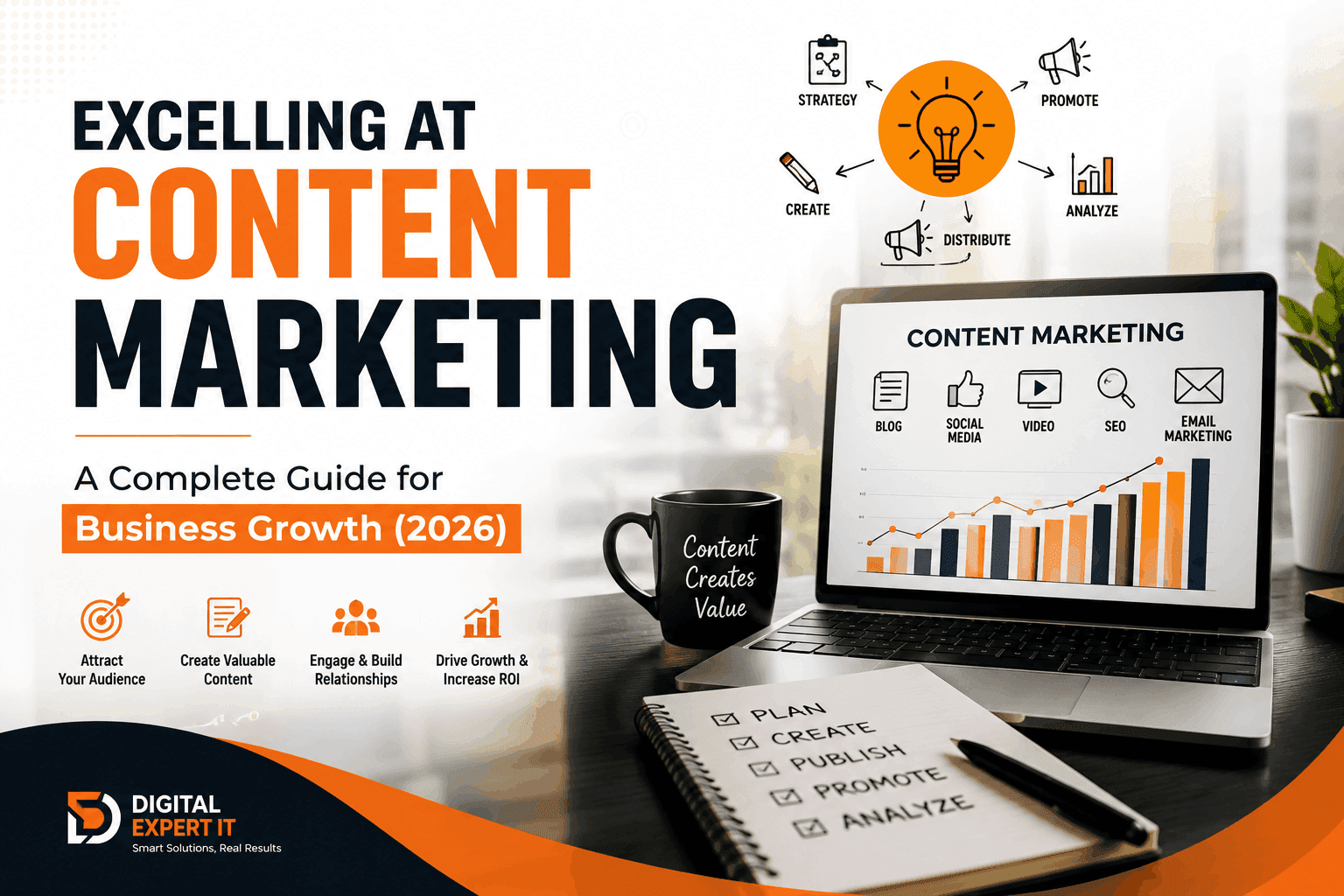 July 20, 20267 min read
Excelling at Content Marketing: A Complete Guide for Business Growth (2026)
D
Digital Expert IT
Author
In today's competitive digital landscape, content marketing has become one of the most effective ways to build trust, attract qualified leads, and increase long-term revenue. Businesses that consistently create valuable, relevant, and engaging content are more likely to outperform competitors who rely solely on paid advertising.
Excelling at content marketing isn't about publishing dozens of blog posts every month. Instead, it's about understanding your audience, solving their problems, and delivering content that builds meaningful relationships over time.
Whether you're a startup, local business, eCommerce brand, or established company, mastering content marketing can transform your online presence and establish your brand as an industry authority.
What Is Content Marketing?
Content marketing is a strategic marketing approach focused on creating and distributing valuable, relevant, and consistent content to attract and retain a clearly defined audience.
Instead of directly promoting products or services, content marketing educates, informs, entertains, or inspires potential customers. This approach naturally builds trust, making people more likely to choose your business when they're ready to make a purchase.
Examples of content marketing include:
- Blog articles
- Educational guides
- Case studies
- Videos
- Infographics
- Social media content
- Email newsletters
- Podcasts
- Whitepapers
- Interactive tools
The goal is simple: provide value first and earn customer loyalty over time.
Why Content Marketing Matters More Than Ever
Modern consumers research extensively before making purchasing decisions. They compare brands, read reviews, watch videos, and seek expert advice.
If your business consistently provides helpful information, customers begin viewing you as a trusted resource rather than just another company trying to make a sale.
Some major benefits include:
- Increased organic website traffic
- Better search engine rankings
- Higher brand awareness
- Improved customer trust
- More qualified leads
- Lower customer acquisition costs
- Stronger customer loyalty
- Higher conversion rates
Unlike paid advertising, quality content continues generating traffic long after it's published.
Understanding Your Target Audience
The foundation of successful content marketing is knowing exactly who you're creating content for.
Ask yourself:
- What problems are my customers facing?
- What questions do they frequently ask?
- What motivates their buying decisions?
- Which platforms do they spend time on?
- What type of content do they enjoy?
Creating detailed customer personas helps ensure every piece of content addresses real needs rather than assumptions.
The more specific your audience research becomes, the more effective your content strategy will be.
Create Content That Solves Problems
The highest-performing content always provides genuine value.
Instead of writing solely about your products or services, focus on helping your audience achieve their goals.
For example:
- Step-by-step tutorials
- Industry insights
- Practical tips
- Expert opinions
- Checklists
- Case studies
- Frequently asked questions
When people consistently find useful answers on your website, they naturally return whenever they need additional guidance.
Helpful content also encourages social sharing, increasing your reach organically.
Focus on SEO Without Overstuffing Keywords
Search engine optimization and content marketing work together.
Great content deserves visibility, while SEO helps search engines understand what your pages are about.
Follow these SEO best practices:
- Use your primary keyword naturally.
- Include related semantic keywords.
- Write compelling headings.
- Optimize your meta title and description.
- Add internal links where relevant.
- Structure content using H2 and H3 headings.
- Write descriptive image alt text.
- Keep paragraphs easy to read.
- Use bullet points for better readability.
Avoid keyword stuffing. Google's algorithms are increasingly focused on content quality, relevance, and user experience.
Natural writing consistently performs better than repetitive keyword-heavy content.
Maintain Consistency
Publishing one excellent article every few months isn't enough.
Consistency builds authority.
Develop a realistic content calendar that includes:
- Weekly blog posts
- Social media updates
- Email newsletters
- Educational videos
- Industry news
- Customer success stories
Search engines reward websites that regularly publish fresh, valuable content.
Consistency also keeps your audience engaged throughout the customer journey.
Diversify Your Content Formats
People consume information differently.
Some prefer reading blogs, while others enjoy watching videos or listening to podcasts.
Consider producing:
- Blog articles
- Short-form videos
- Long-form educational videos
- Infographics
- Downloadable guides
- Webinars
- Social media carousels
- Customer interviews
Repurposing one piece of content into multiple formats extends its reach and saves valuable production time.
Measure Performance Regularly
You can't improve what you don't measure.
Track important metrics such as:
- Organic traffic
- Keyword rankings
- Average session duration
- Bounce rate
- Conversion rate
- Backlinks
- Social shares
- Email signups
- Lead generation
Review your analytics monthly to identify which topics generate the highest engagement.
Use those insights to shape your future content strategy.
Build Authority Through Expertise
Google increasingly values Experience, Expertise, Authoritativeness, and Trustworthiness (E-E-A-T).
Ways to build authority include:
- Publishing original research
- Sharing real client experiences
- Including expert insights
- Updating outdated content
- Citing reliable industry data
- Demonstrating practical experience
Trust is earned through consistency, accuracy, and transparency.
Businesses that invest in high-quality educational content naturally become trusted industry leaders.
Promote Your Content Effectively
Creating great content is only half the process.
Promotion ensures it reaches the right audience.
Share your content through:
- Email marketing
- Industry communities
- Online forums
- Business partnerships
Encourage employees and satisfied customers to share your content as well.
Greater visibility leads to more backlinks, increased traffic, and stronger search rankings.
How Digital Expert IT Helps Businesses Grow
Building a successful content marketing strategy requires planning, creativity, SEO knowledge, and ongoing optimization. Businesses looking to strengthen their online presence can benefit from partnering with experienced professionals who understand both search engines and customer behavior.
At Digital Expert IT, we help businesses create content strategies that attract qualified traffic, improve search visibility, and generate measurable business growth. Learn more about our digital marketing solutions on Digital Expert IT's services page and discover additional insights and resources by visiting the Digital Expert IT website.
Common Content Marketing Mistakes
Many businesses struggle because they make avoidable mistakes, including:
- Publishing inconsistent content
- Ignoring keyword research
- Writing only promotional articles
- Forgetting to update old content
- Not measuring results
- Targeting overly broad audiences
- Neglecting mobile optimization
- Producing low-quality or AI-generated content without human editing
Avoiding these mistakes significantly improves long-term SEO performance.
Conclusion
Excelling at content marketing requires much more than publishing articles. It demands a deep understanding of your audience, a commitment to delivering genuine value, and a consistent strategy focused on education rather than promotion.
Businesses that prioritize helpful, well-optimized, and trustworthy content build stronger relationships with customers, achieve higher search rankings, and generate sustainable growth over time.
As search engines continue rewarding quality over quantity, investing in authentic, audience-focused content has never been more important. By combining strategic planning, SEO best practices, and continuous improvement, your business can establish lasting authority and remain competitive in an increasingly crowded digital marketplace.
Frequently Asked Questions (FAQs)
1. What is content marketing?
Content marketing is a strategy that involves creating valuable and relevant content to attract, engage, and convert a specific audience without relying solely on direct advertising.
2. Why is content marketing important for SEO?
High-quality content helps search engines understand your website, improves keyword rankings, earns backlinks, and increases organic traffic over time.
3. How often should I publish content?
Consistency is more important than frequency. Publishing one or two well-researched, high-quality articles each week is often more effective than posting low-quality content daily.
4. What types of content perform best?
Educational blogs, case studies, videos, how-to guides, industry insights, FAQs, and customer success stories generally deliver the best long-term results.
5. How long does content marketing take to show results?
Most businesses begin seeing measurable SEO improvements within three to six months, while stronger authority and sustained organic growth often develop over six to twelve months.
6. Can small businesses benefit from content marketing?
Absolutely. Content marketing helps small businesses compete with larger brands by building authority, increasing organic visibility, and attracting qualified leads without requiring massive advertising budgets.
7. How do I measure content marketing success?
Key performance indicators include organic traffic, keyword rankings, conversions, engagement metrics, backlinks, lead generation, and return on investment (ROI).
8. Does content marketing still work in 2026?
Yes. As search engines continue prioritizing helpful, experience-driven, and user-focused content, content marketing remains one of the most effective long-term digital marketing strategies for businesses of every size.