49/08, Nirala Residential Area, Khulna
contact@digitalexpertit.com
←Back to Articles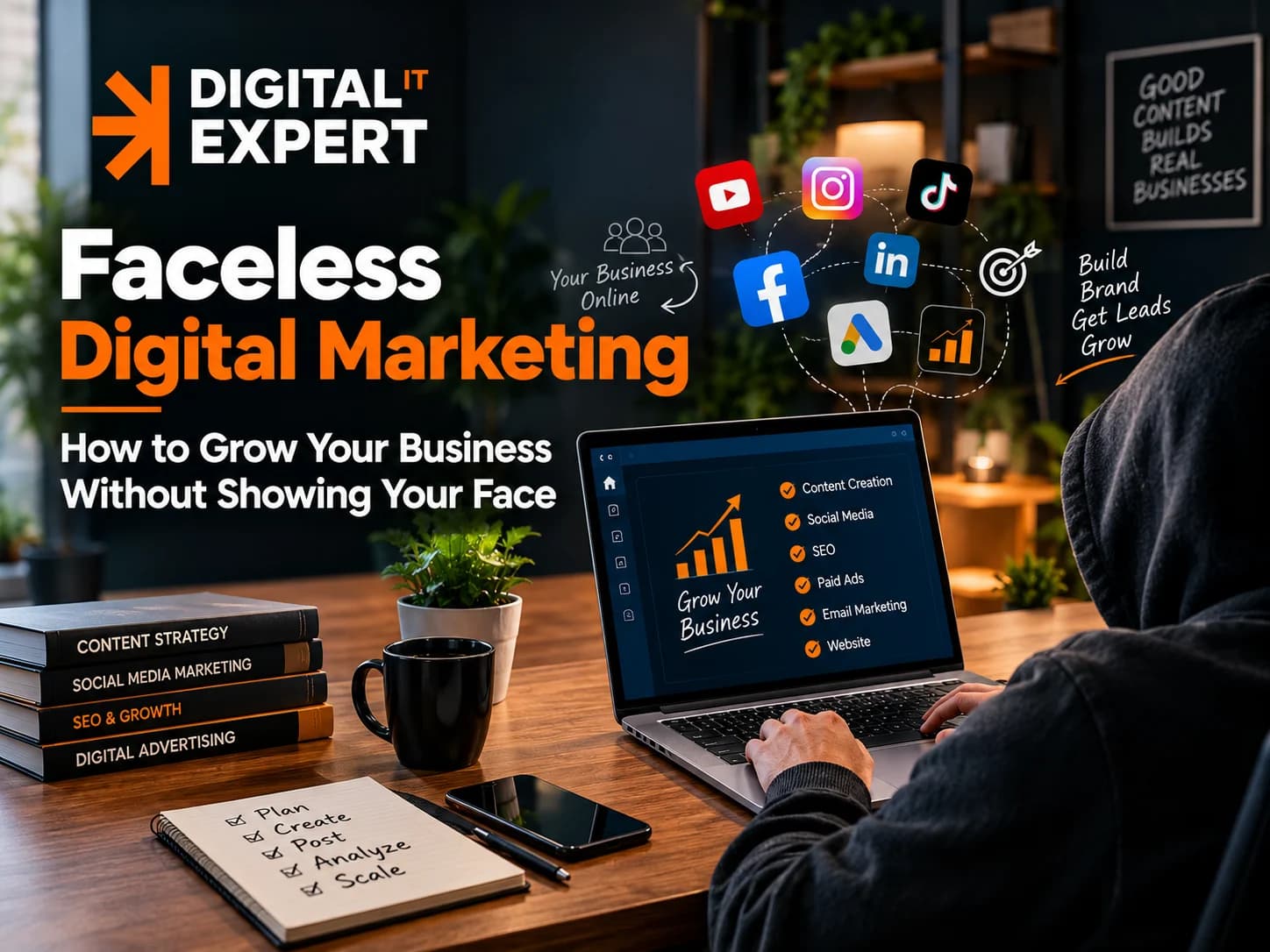 October 7, 20269 min read
Faceless Digital Marketing: How to Grow Your Business Without Showing Your Face
D
Digital Expert IT
Author
You don't have to become an influencer to build a successful online business.
For years, digital marketing has been closely associated with personal branding, talking-head videos, selfies, and constantly appearing on Instagram, TikTok, YouTube, or LinkedIn. But that approach isn't right for everyone.
Some business owners prefer privacy. Some are uncomfortable being on camera. Others simply want their business to be bigger than one person's personality.
That's where faceless digital marketing comes in.
Faceless digital marketing allows you to promote a business, product, service, or online brand without making your face the center of your marketing strategy. Instead, the focus shifts toward valuable content, strong branding, search visibility, social media, automation, and a clear customer journey.
And no, faceless doesn't mean invisible.
What Is Faceless Digital Marketing?
Faceless digital marketing is a marketing approach where a business builds its online presence without depending on a visible founder or content creator.
Instead of filming yourself talking to the camera, you can use:
- Educational videos with text and graphics
- Screen recordings and tutorials
- Voiceovers
- Short-form videos using relevant footage
- Blog posts and SEO content
- Infographics and carousels
- Product demonstrations
- Email marketing
- Paid advertising
- Automated customer journeys
The important part is that the value comes from the content and the brand—not necessarily from the person's face behind it.
This makes faceless marketing useful for businesses that want to build a professional online presence while keeping their founders or employees behind the scenes.
Why Is Faceless Marketing Becoming Popular?
One major reason is simple: not everyone wants to be a public personality.
Running a business already requires time, attention, and decision-making. Adding daily filming, personal videos, and constant social media appearances can become exhausting.
Faceless marketing provides another option.
It can also make content production easier to delegate. A designer can create graphics, a video editor can produce short-form videos, a writer can handle blog content, and a marketer can manage distribution and advertising.
The result is a marketing system that doesn't completely depend on one person showing up every day.
Another advantage is consistency. A strong brand can continue publishing useful content even when the founder is busy.
How Does Faceless Digital Marketing Work?
A successful faceless strategy usually combines several digital channels rather than relying on one platform.
1. Build a Strong Brand Identity
If people don't recognize the person behind your business, your brand needs to become recognizable.
Use consistent colors, typography, messaging, imagery, and tone across your website and social media profiles.
Your audience should be able to recognize your content before they even read the account name.
A clear niche also helps. Instead of trying to talk about everything, focus on a specific audience and the problems you solve for them.
2. Create Content That Provides Real Value
Faceless content still needs personality—it just doesn't need a face.
For example, a software company could create:
- “5 Website Mistakes That Lose Customers”
- “How to Automate Your Sales Follow-Up”
- “Website vs. Web App: What's the Difference?”
- “3 Ways to Improve Your Online Store”
These topics can be turned into blog posts, carousels, short videos, infographics, or email content without requiring anyone to appear on camera.
The goal isn't simply to produce content.
The goal is to answer questions your potential customers are already asking.
3. Use SEO to Attract Search Traffic
SEO is particularly useful for faceless businesses because search engines don't require you to be a celebrity.
A well-optimized website can attract visitors based on what they are searching for.
For example, someone searching for “digital marketing for small businesses,” “how to automate business tasks,” or “custom website development” already has a specific problem or goal.
Creating useful content around these topics gives your business an opportunity to appear when potential customers are actively looking for solutions.
Over time, a collection of high-quality articles can become a valuable traffic source.
4. Use Social Media Without Becoming an Influencer
You can build an active social media presence without posting selfies every day.
Faceless social media content can include:
- Educational carousels
- Animated graphics
- Screen recordings
- Product walkthroughs
- Customer success stories
- Before-and-after examples
- Industry statistics
- Short educational videos
- Behind-the-scenes business processes
The key is to make your content recognizable and useful.
A faceless account that simply reposts generic quotes will struggle to build authority. A faceless brand that consistently solves problems can become a trusted resource.
5. Turn Attention Into Leads
Getting views is not the final goal.
Your content should eventually lead people toward a useful next step.
That could be downloading a resource, joining an email list, requesting a quote, booking a consultation, or visiting a service page.
Your website becomes especially important here because social media attention can disappear quickly. A website gives your business a place where interested visitors can learn more and take action.
For businesses looking to build a stronger online marketing system, Digital Expert IT provides digital solutions covering areas such as marketing, website development, SEO, and other growth-focused services.
Can Faceless Digital Marketing Actually Make Money?
Yes, but it is important to have realistic expectations.
Faceless digital marketing isn't a magic formula for instant income. The same fundamentals still apply: you need a valuable offer, the right audience, useful content, consistent distribution, and a conversion process.
There are several ways a faceless brand can generate revenue.
For example:
Affiliate marketing: Promote relevant products or services and earn a commission from qualified purchases.
Digital products: Sell templates, guides, courses, ebooks, software, or other downloadable resources.
Lead generation: Build traffic and generate qualified leads for a business.
Advertising: Monetize content through relevant advertising once you have enough traffic.
Services: Use content to attract customers for professional services.
E-commerce: Drive visitors toward physical or digital products through content and advertising.
The strongest approach depends on the business model and target audience.
Best Faceless Digital Marketing Strategies for Beginners
If you're starting from scratch, don't try to dominate every platform at once.
Start with one audience, one primary content format, and one main conversion goal.
For example, you could build a niche website around SEO content and use Instagram or LinkedIn to distribute your articles.
Or you could create educational short-form videos and send interested viewers to a service page.
You can also combine SEO, social media management, paid advertising, content creation, and conversion optimization into one connected system. A structured digital marketing service strategy can help businesses connect these individual activities instead of treating each channel separately.
The biggest mistake beginners make is focusing on posting volume instead of business results.
Ten useful pieces of content that reach the right people can be more valuable than one hundred generic posts.
Common Mistakes to Avoid
Faceless marketing has plenty of potential, but there are a few traps to avoid.
Using generic content: If your posts could belong to any business, they probably won't build much authority.
Depending completely on AI: AI can speed up research and production, but publishing unchecked, repetitive content can make your brand feel robotic.
Chasing every trend: Trends can bring short-term attention, but your strategy should be built around your customers and business goals.
Ignoring trust: Being faceless doesn't mean being anonymous in every sense. Show your expertise through case studies, reviews, useful information, transparent business details, and consistent branding.
Expecting instant results: SEO and content marketing often take time. Treat your content as a long-term business asset rather than a quick shortcut.
Final Thoughts
Faceless digital marketing proves that you don't have to become the face of your business to build a strong online presence.
Your brand can grow through useful content, SEO, social media, paid advertising, email marketing, automation, and a website designed to turn attention into action.
The most important thing is not whether your audience sees your face.
It's whether they see value.
If your content consistently answers questions, solves problems, demonstrates expertise, and gives people a clear next step, your business can build visibility and trust without putting a personality at the center of every campaign.
Faceless marketing isn't about hiding.
It's about building a marketing system where your brand, content, and customer experience do the talking.
FAQs About Faceless Digital Marketing
1. What is faceless digital marketing?
Faceless digital marketing is a strategy for promoting a business, product, service, or online brand without making an individual's face the primary focus of the marketing. It can include SEO, blogging, social media content, videos, email marketing, paid advertising, and automation.
2. Does faceless digital marketing really work?
Yes, it can work when it is built around a clear audience, useful content, strong branding, and a good conversion strategy. Being faceless doesn't replace the fundamentals of marketing—it simply changes how the brand communicates with its audience.
3. How can I start faceless digital marketing as a beginner?
Start by choosing a specific niche and identifying the problems your audience wants to solve. Then create useful content around those problems, choose one or two marketing channels, build a professional website, and create a clear path from content to your product or service.
4. What are the best faceless digital marketing platforms?
SEO-focused websites, Instagram, Facebook, YouTube, Pinterest, LinkedIn, email marketing, and paid advertising can all support a faceless marketing strategy. The best platform depends on where your target audience spends time and what type of content you can consistently produce.
5. Can I make money with faceless digital marketing?
Yes. Common revenue models include affiliate marketing, digital products, advertising, lead generation, e-commerce, and professional services. However, income isn't guaranteed and usually depends on the quality of the offer, audience, content, traffic, and conversion process.
6. Do I need to show my face on social media to grow?
No. You can create educational graphics, carousels, screen recordings, tutorials, animations, voiceovers, product demonstrations, and other forms of content without appearing on camera. What matters most is whether the content is useful and relevant to your target audience.
7. Is faceless digital marketing the same as personal branding?
No. Personal branding places an individual at the center of the marketing strategy, while faceless digital marketing places more emphasis on the company, niche, content, product, or service. Both approaches can work, but they require different content and trust-building strategies.