49/08, Nirala Residential Area, Khulna
contact@digitalexpertit.com
←Back to Articles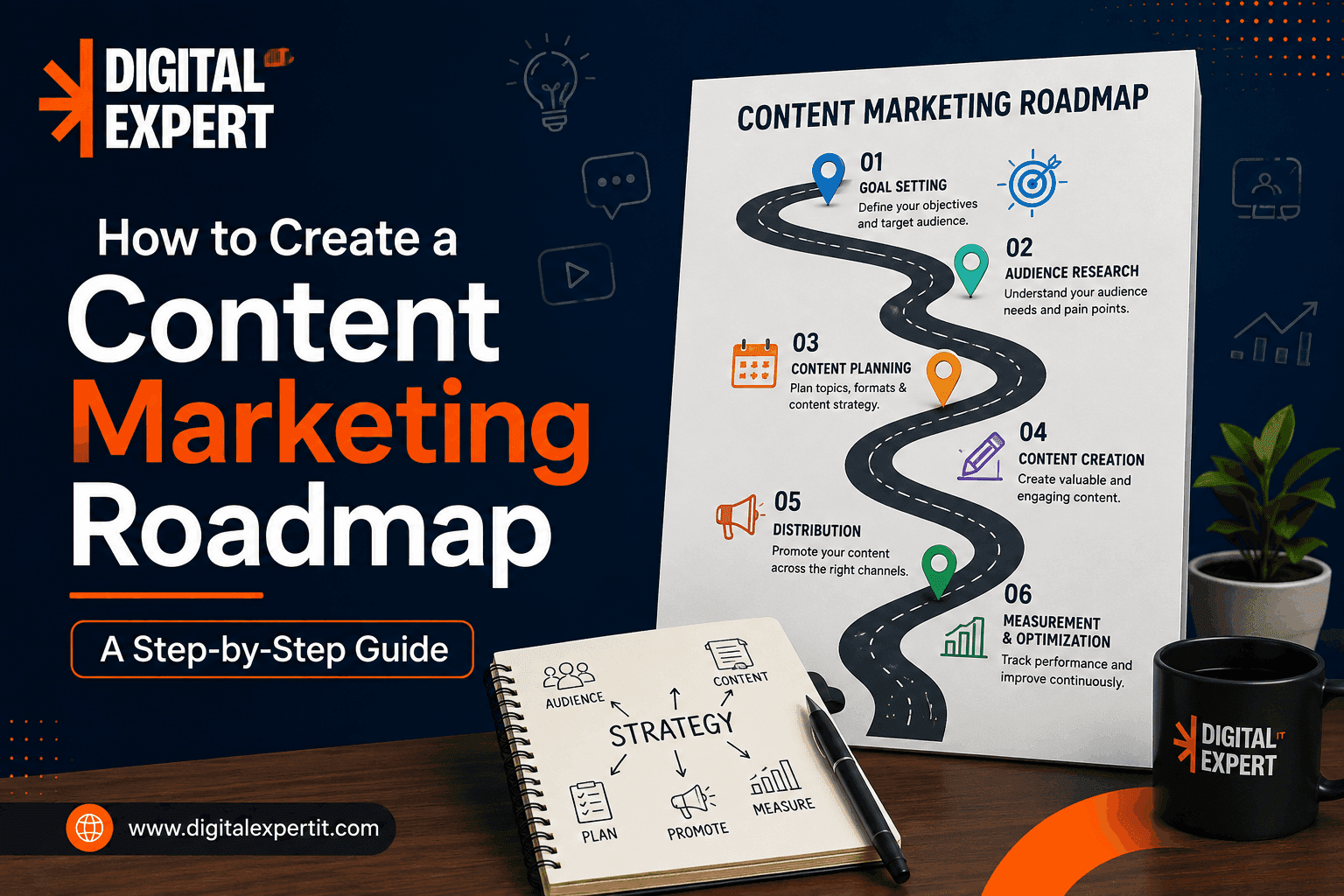 August 16, 20269 min read
How to Create a Content Marketing Roadmap: A Step-by-Step Guide
D
Digital Expert IT
Author
Content marketing can generate traffic, build trust, and bring in qualified leads—but only when there is a clear plan behind it. Publishing a blog today, a social media post tomorrow, and a random video next week may keep your channels active, but it does not necessarily create business growth.
That is where a content marketing roadmap comes in.
A content marketing roadmap gives your team a clear direction: what to create, who it is for, when it should be published, which channels should distribute it, and how success will be measured. It turns scattered content ideas into an organized strategy connected to real business goals.
If you are wondering how to create a content marketing roadmap, here is a practical process you can follow.
What Is a Content Marketing Roadmap?
A content marketing roadmap is a strategic plan that organizes your content activities over a specific period. It can include blog posts, videos, social media content, landing pages, email campaigns, case studies, and other marketing assets.
Unlike a simple content calendar, a roadmap focuses on the bigger picture. It connects individual content pieces with your audience, business objectives, SEO opportunities, and customer journey.
For example, instead of simply planning to publish four blog posts in a month, your roadmap might identify:
- The business goal behind the content
- The target audience
- Primary and secondary keywords
- Content topics and clusters
- Publishing schedule
- Distribution channels
- Responsible team members
- KPIs and performance targets
This makes your content marketing much more intentional.
1. Define Your Content Marketing Goals
Start by deciding what you actually want your content to accomplish.
Your goal could be increasing organic traffic, generating leads, improving brand awareness, educating customers, supporting sales, or increasing conversions.
Try to make your goals measurable. Instead of saying, “We want more website traffic,” define a target such as increasing organic traffic by 20% over six months.
Your goals should influence every later decision in the roadmap. A business focused on lead generation will create different content from one primarily focused on brand awareness.
2. Understand Your Target Audience
Great content starts with understanding the people you want to reach.
Identify your ideal customers and learn about their:
- Problems and challenges
- Questions and concerns
- Buying motivations
- Search behavior
- Preferred content formats
- Decision-making process
Think about what your audience searches for before they know your business exists.
For example, someone looking for web development may first search for “how much does a business website cost?” before searching for a web development company.
These early questions can become valuable content opportunities.
3. Audit Your Existing Content
Before creating dozens of new articles, look at what you already have.
Review your existing blogs, landing pages, videos, social posts, and other content. Identify which pieces are performing well and which ones need improvement.
Look for content that:
- Generates organic traffic
- Has backlinks
- Ranks on Google
- Produces leads
- Is outdated
- Has declining traffic
- Covers similar topics to another page
A content audit can reveal that updating an existing page may be more valuable than creating another new one. Modern content roadmaps commonly use audits to identify content worth refreshing, consolidating, or replacing.
4. Research Keywords and Search Intent
Keyword research is an important part of an SEO-focused content marketing roadmap.
Start by finding keywords your potential customers actually search for. Then group related keywords into broader topics or content clusters.
Do not focus only on search volume. Consider:
- Search intent
- Keyword difficulty
- Business relevance
- Competition
- Potential to generate leads or sales
For example, what is digital marketing may have informational intent, while digital marketing agency for small business has stronger commercial intent.
Understanding intent helps you create content that matches what users expect to find. A useful content calendar should be built from strategy and keyword priorities rather than simply filling dates with random topics.
5. Create Content Pillars and Topic Clusters
Once you have your keywords, organize them into content pillars.
A content pillar is a broad subject your business wants to become known for. Supporting articles then cover specific questions and subtopics related to that pillar.
For example, a digital marketing company might create pillars around:
- SEO
- Content Marketing
- Social Media Marketing
- Paid Advertising
- Web Development
- Video Marketing
Under SEO, you could publish supporting topics such as keyword research, technical SEO, local SEO, on-page optimization, and website speed.
This structure creates a more organized website and helps you build topical depth instead of publishing unrelated articles.
6. Choose the Right Content Formats
Not every topic should become a 1,200-word blog post.
Your roadmap should include different formats depending on audience preferences and search intent.
Consider using:
- Blog articles
- How-to guides
- Case studies
- Short-form videos
- Reels and Shorts
- Infographics
- Email newsletters
- Landing pages
- Webinars
- Downloadable guides
For example, a complicated tutorial might work well as both a detailed blog post and a short video series.
Repurposing one strong idea into multiple formats can help you get more value from your content production efforts.
7. Build a Realistic Content Calendar
Now turn your strategy into an actionable schedule.
Your content calendar should show what is being created, when it will be published, who is responsible, and where it will be distributed.
A simple structure can include:
Topic → Keyword → Content Type → Author → Publish Date → Distribution Channel → Status → Performance
Do not make the calendar unnecessarily complicated. Consistency is usually more useful than setting an unrealistic publishing frequency.
One high-quality, strategically targeted article every week can be more valuable than several rushed posts that do not satisfy the audience or search intent.
8. Plan Content Distribution
Publishing is only half of content marketing.
Once an article or video goes live, decide how you will get it in front of the right people.
Your distribution plan might include:
- Google search
- YouTube
- Email newsletters
- Online communities
- Internal website links
For example, one blog post can become a LinkedIn post, Instagram carousel, short video, email topic, and several social media snippets.
This approach increases the reach of your original content without requiring you to create everything from scratch.
9. Set KPIs and Track Performance
Your roadmap should include clear metrics.
Depending on your goals, you can track:
- Organic traffic
- Keyword rankings
- Click-through rate
- Time on page
- Engagement
- Leads
- Conversion rate
- Backlinks
- Email sign-ups
- Revenue influenced by content
Do not judge every article using the same metric. A top-of-funnel educational article may be successful because it attracts qualified traffic, while a service-focused page should be evaluated more heavily on leads and conversions.
10. Review and Improve the Roadmap
A content marketing roadmap should not be a document you create once and forget.
Review performance regularly—monthly or quarterly—and adjust your priorities.
If a topic performs exceptionally well, create related content. If an article receives impressions but few clicks, improve its title and meta description. If a page ranks on the second page of Google, consider updating and strengthening it.
The best content strategies are iterative. You publish, measure, learn, and improve.
Final Thoughts
Learning how to create a content marketing roadmap is really about creating a repeatable system rather than simply making a list of blog topics.
Start with business goals, understand your audience, research keywords, organize content into meaningful topics, choose appropriate formats, create a realistic calendar, distribute your content, and measure the results.
If you need professional help with content marketing, SEO, web development, or digital growth, Digital Expert IT can help you build a strategy around your business goals. You can also explore the company’s digital marketing and related services to see how different marketing solutions can work together.
Remember: successful content marketing is rarely about publishing the most content. It is about publishing the right content for the right audience at the right time—and continuously improving it based on real results.
FAQs About Creating a Content Marketing Roadmap
1. What is a content marketing roadmap?
A content marketing roadmap is a strategic plan that outlines what content a business should create, when it should be published, how it will be distributed, and how its performance will be measured.
2. How do I create a content marketing roadmap?
Start by defining your business goals and target audience. Then audit existing content, conduct keyword research, identify content pillars, choose formats, build a publishing calendar, plan distribution, and establish KPIs.
3. What should a content marketing roadmap include?
A good roadmap should include content topics, target keywords, audience, search intent, content formats, publishing dates, distribution channels, responsible team members, priorities, and performance metrics.
4. What is the difference between a content roadmap and a content calendar?
A content calendar mainly shows when content will be published. A content roadmap goes further by explaining why the content is being created, which business goal it supports, who it targets, and how the content will be produced and measured.
5. How often should I update my content marketing roadmap?
Review your roadmap at least monthly and perform a deeper strategic review every quarter. Update priorities when audience behavior, search trends, business goals, or content performance changes.
6. Is keyword research necessary for a content marketing roadmap?
For an SEO-driven roadmap, yes. Keyword research helps you understand what your audience searches for and allows you to prioritize topics based on relevance, intent, competition, and business value.
7. How long does it take to see content marketing results?
Content marketing and SEO usually require consistent effort. Some content can generate results quickly, but meaningful organic growth often takes several months. Results depend on competition, website authority, content quality, search intent, and consistency.
8. Can small businesses use a content marketing roadmap?
Absolutely. In fact, a roadmap can help small businesses avoid wasting limited time and resources. A focused plan allows them to prioritize the topics and channels most likely to reach their ideal customers.