49/08, Nirala Residential Area, Khulna
contact@digitalexpertit.com
←Back to Articles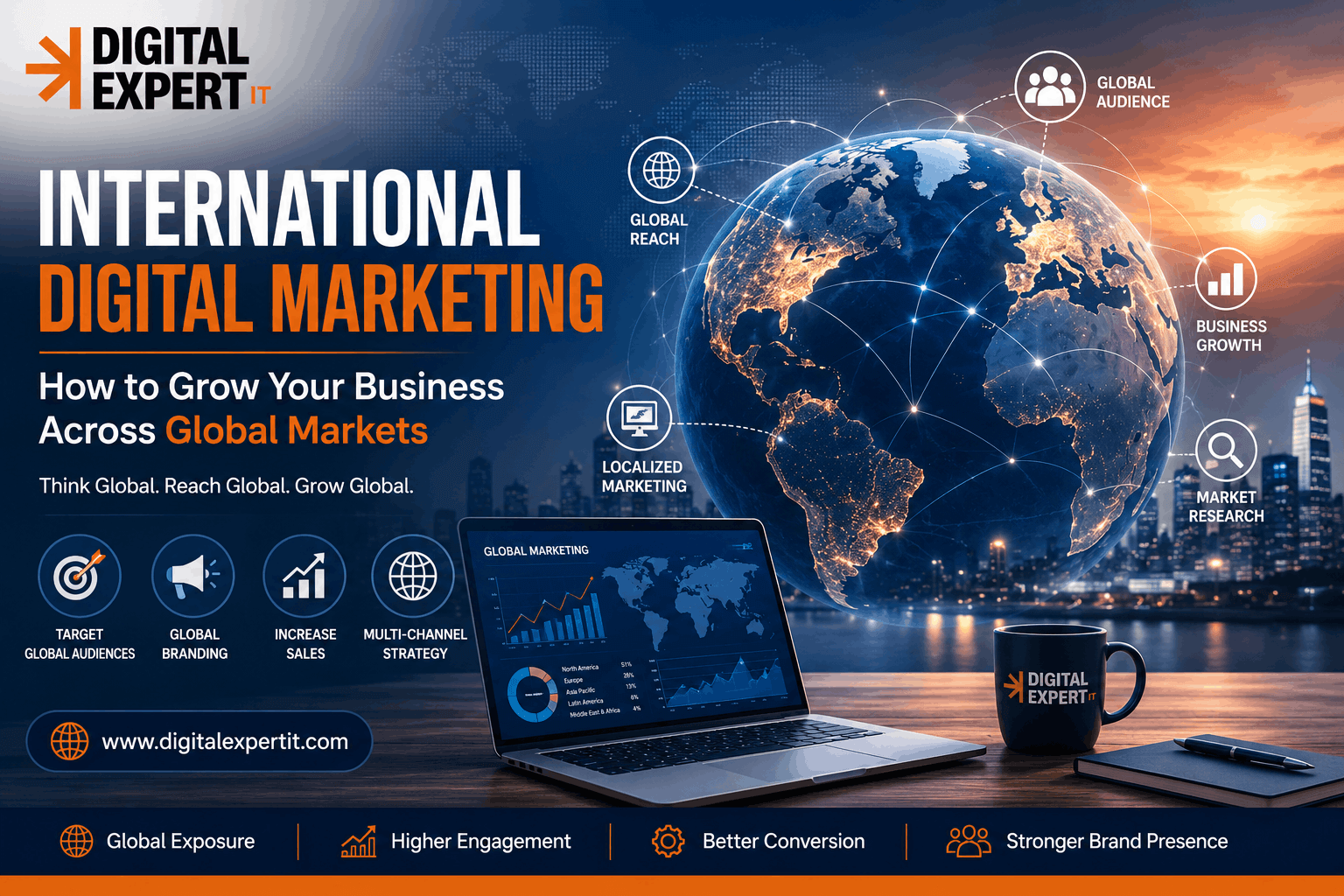 August 7, 20268 min read
International Digital Marketing: How to Grow Your Business Across Global Markets
D
Digital Expert IT
Author
Businesses are no longer limited by geography. A company in New York can sell to customers in London, Dubai, Toronto, or Sydney without opening a physical office in those locations. But reaching international customers successfully takes more than translating a website or running the same advertisement in every country.
This is where international digital marketing becomes important.
International digital marketing is the process of promoting a business, product, or service across multiple countries and markets using digital channels such as search engines, social media, paid advertising, email marketing, content marketing, and websites. The goal is not simply to reach people in different countries, but to connect with the right audience in a way that feels relevant to their culture, language, needs, and buying behavior.
What Is International Digital Marketing?
International digital marketing is a global approach to online marketing where businesses target audiences in different countries or regions.
Unlike traditional digital marketing, international campaigns require marketers to understand differences between markets. Search behavior, customer expectations, language, competition, pricing, cultural preferences, and even social media usage can vary significantly from one country to another.
For example, a marketing strategy that performs well in the United States may not produce the same results in Germany or Australia. The messaging, keywords, content, advertising platforms, and customer journey may need to be adjusted for each market.
A successful international digital marketing strategy combines a consistent global brand identity with localized marketing tactics.
Why Is International Digital Marketing Important?
The internet has made international expansion more accessible than ever. Even small and medium-sized businesses can now attract customers outside their home market without investing heavily in physical locations.
Here are some of the biggest benefits.
1. Reach New Customers
Expanding into international markets gives businesses access to new audiences. Instead of depending entirely on local customers, companies can build multiple sources of revenue across different regions.
This can be especially valuable when growth in the domestic market begins to slow down.
2. Build Global Brand Awareness
A strong online presence can help a business become recognizable beyond its home country. Consistent branding across websites, social media platforms, videos, and advertising campaigns helps create trust with international audiences.
Over time, this can turn a local company into a recognizable global brand.
3. Increase Revenue Opportunities
International markets can create additional sales opportunities. Different countries may have different levels of demand for the same product or service.
With proper market research and targeted campaigns, businesses can identify locations where their offerings have strong potential.
4. Use Data to Make Better Decisions
Digital marketing provides measurable data. Businesses can monitor website traffic, conversion rates, advertising performance, search rankings, customer engagement, and other important metrics.
This makes it easier to determine which countries and campaigns are generating the best results.
Key Strategies for International Digital Marketing
Expanding internationally requires more than launching advertisements in another country. Businesses need a clear strategy.
International SEO
International SEO helps search engines understand which versions of a website should appear for users in different countries and languages.
Keyword research is particularly important. A keyword that receives thousands of searches in one market may have very little demand in another.
Businesses should research local search terms, optimize pages for target markets, create useful localized content, and structure their websites properly for international audiences.
Localized Content Marketing
Translation and localization are not exactly the same thing.
Translation converts words from one language to another. Localization adapts the content to the culture, expectations, expressions, and preferences of a particular market.
For example, headlines, examples, calls to action, images, and offers may need to change depending on the target country.
High-quality localized content feels natural rather than like a translated advertisement.
International Social Media Marketing
Social media can be an effective way to build awareness in new markets. However, businesses should understand which platforms are popular with their target audience.
Content should also consider local trends, cultural references, posting schedules, languages, and audience interests.
Short-form videos, educational content, customer stories, and localized promotional campaigns can help brands build relationships with international audiences.
Global Paid Advertising
Platforms such as Google Ads and social media advertising allow businesses to target specific countries, cities, languages, demographics, and interests.
However, international paid advertising should not rely on one campaign for every location.
Creating market-specific campaigns can make it easier to test different messages, offers, audiences, and creative assets. Businesses can then move more budget toward the markets producing stronger results.
Website Localization
Your website is often the first major interaction an international customer has with your brand.
A global website should provide a smooth experience for visitors from different regions. Depending on the business, this may include localized language, currency, pricing, contact information, shipping details, payment options, and market-specific content.
Website speed and mobile responsiveness are also important because international visitors may access the site from different devices and network conditions.
Common Challenges in International Digital Marketing
Global marketing can create significant opportunities, but it also comes with challenges.
Cultural differences are one of the biggest. Colors, phrases, images, humor, and advertising styles can have different meanings across countries.
Competition is another challenge. Entering a new market often means competing with businesses that already understand the local audience.
There are also technical and SEO considerations, including multilingual websites, international keyword research, country targeting, and website architecture.
Finally, businesses need to understand local regulations related to advertising, privacy, data collection, and online transactions.
How to Build an International Digital Marketing Strategy
A practical approach starts with research.
First, identify the countries where your products or services have the strongest potential. Analyze demand, competitors, customer behavior, search trends, and market conditions.
Next, define your target audience for each market. Avoid treating an entire country as one audience.
Then develop localized content and campaigns. Test different messaging, creative formats, keywords, and offers.
After launching campaigns, monitor performance carefully. Metrics such as organic traffic, cost per lead, conversion rate, customer acquisition cost, and return on advertising spend can help determine what is working.
The process should be continuous. International marketing becomes more effective when businesses test, learn, optimize, and adapt to each market.
The Role of a Digital Marketing Partner
Managing multiple international markets can quickly become complicated. Businesses may need expertise across SEO, paid advertising, social media, content creation, analytics, website optimization, and conversion tracking.
Working with an experienced digital marketing team can help businesses create a more organized growth strategy and avoid costly mistakes.
At Digital Expert IT, businesses can explore digital marketing and technology solutions designed to improve their online presence, generate qualified leads, and support long-term growth. You can also explore the company's digital marketing and other professional services to find solutions that fit your business goals.
Final Thoughts
International digital marketing gives businesses the opportunity to reach customers far beyond their local market. But successful global growth does not come from simply translating a website or increasing an advertising budget.
It requires research, localization, strong SEO, relevant content, targeted advertising, a user-friendly website, and continuous optimization.
The businesses that understand the differences between markets—and adapt their strategies accordingly—are more likely to build meaningful relationships with international customers.
If your goal is to take your business beyond one market, a well-planned international digital marketing strategy can become a powerful foundation for sustainable global growth.
FAQs About International Digital Marketing
What is international digital marketing?
International digital marketing is the practice of using online marketing channels to promote a business across multiple countries or regions. It includes SEO, paid advertising, social media, content marketing, email marketing, and website optimization.
Why is international digital marketing important?
It helps businesses reach new customers, enter new markets, increase brand awareness, and create additional revenue opportunities beyond their domestic market.
What is the difference between global marketing and international marketing?
Global marketing generally focuses on maintaining a consistent strategy and brand worldwide, while international marketing often involves adapting campaigns to individual countries or regions. In practice, successful businesses commonly combine both approaches.
Is international SEO different from regular SEO?
Yes. International SEO focuses on targeting users in different countries or languages. It requires additional keyword research, localization, website structure, and technical SEO considerations.
How can a small business start international digital marketing?
A small business can begin by selecting one or two promising markets, researching local demand and competition, localizing its website and content, and launching targeted SEO or paid advertising campaigns before expanding further.
How long does international digital marketing take to produce results?
The timeline depends on the strategy and channel. Paid advertising can generate traffic relatively quickly, while SEO and content marketing generally require more time to build sustainable organic visibility. Consistent testing and optimization are essential.
Can international digital marketing help with lead generation?
Yes. International campaigns can target specific audiences based on location, interests, search behavior, and other relevant factors. When combined with strong landing pages and conversion tracking, digital marketing can generate qualified leads from multiple markets.