49/08, Nirala Residential Area, Khulna
contact@digitalexpertit.com
←Back to Articles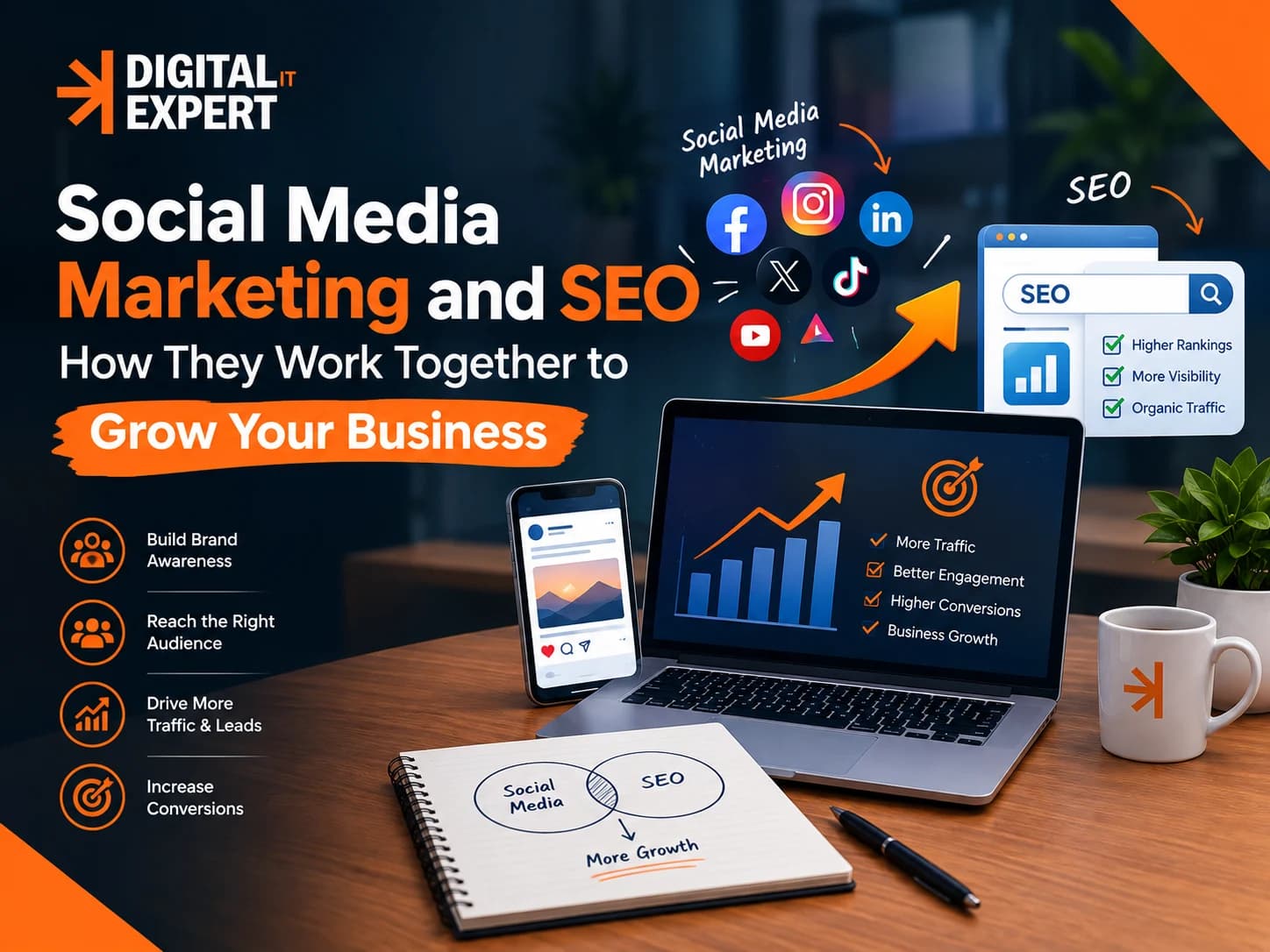 September 16, 202610 min read
Social Media Marketing and SEO: How They Work Together to Grow Your Business
D
Digital Expert IT
Author
If you want your business to grow online, focusing on only one marketing channel is rarely enough. Your customers may discover your brand through Google, Instagram, Facebook, YouTube, LinkedIn, or a recommendation from someone they follow.
This is where social media marketing and SEO become especially powerful together.
SEO helps your website become more visible when people actively search for products, services, or information. Social media marketing helps you reach people where they already spend their time, build relationships, distribute content, and create conversations around your brand.
Although social media signals are not simply a direct ranking shortcut for Google, the two strategies can support each other in practical ways. Google has also expanded its ability to surface and measure content from social and video platforms in Search.
So, instead of treating social media and SEO as separate marketing activities, businesses should think of them as parts of one larger digital growth strategy.
What Is Social Media Marketing and SEO?
Social media marketing involves using platforms such as Facebook, Instagram, LinkedIn, TikTok, and YouTube to promote a business, share content, engage with audiences, and generate leads or sales.
Search engine optimization (SEO) is the process of improving your website and content so search engines can understand it and users can discover it through relevant searches.
The goals are slightly different:
- Social media helps you reach and engage people.
- SEO helps you capture people who are actively searching.
- Social content can help distribute your ideas to a wider audience.
- SEO can help valuable website content continue attracting visitors over time.
When combined strategically, they can create a stronger customer journey from discovery to conversion.
Why Social Media Marketing and SEO Should Work Together
Imagine you publish an excellent blog post about your industry.
You optimize it for relevant search terms, improve the page structure, and publish it on your website. That's the SEO side.
But you don't stop there.
You turn the main points into an Instagram carousel, a LinkedIn post, a short video, and a Facebook post. Now you're distributing the same core knowledge across several channels.
Someone might discover the social post first. Another person may find the article through Google weeks later. Someone else may see your video, visit your profile, and eventually search for your business by name.
This creates multiple opportunities for people to encounter your brand.
Google's current documentation also recognizes that content published on social and video platforms can be discovered through Google Search and recommends using Search Console to analyze that performance.
1. Social Media Can Increase Content Exposure
One of the biggest challenges with SEO is simply getting your content in front of people.
Publishing a blog doesn't automatically mean thousands of people will read it.
Social media gives you another distribution channel.
For example, a business could publish a detailed guide on its website and then create:
- A LinkedIn post highlighting three key lessons
- An Instagram carousel summarizing the article
- A short video explaining the main problem
- A Facebook post asking an industry-related question
- A YouTube video expanding on the topic
The website remains the main content destination, while social platforms help introduce that content to new audiences.
2. Social Media Helps You Understand Your Audience
SEO data can tell you what people search for, but social media can reveal how people actually talk about their problems.
Comments, questions, direct messages, polls, and discussions can provide valuable insights.
Suppose you run a web development company and repeatedly see potential customers asking:
“Why is my website getting traffic but no leads?”
That question could become:
- A blog article
- A service page
- A LinkedIn post
- An Instagram carousel
- A YouTube video
- An FAQ section
This is a practical way to turn real customer conversations into content opportunities.
3. SEO Gives Your Social Content a Longer-Term Strategy
Social content can move quickly. A post may receive most of its attention within a short period.
SEO content can have a much longer lifespan.
A useful article targeting a relevant search query can continue attracting visitors after the original social promotion has ended.
That doesn't mean every blog will rank or remain visible indefinitely. Search visibility depends on many factors, including relevance, quality, competition, technical accessibility, and how useful the page is for the searcher.
Google's Search Essentials specifically emphasizes following technical requirements and spam policies, while its documentation warns against tactics such as keyword stuffing and manipulative link practices.
4. Build Content Around Search Intent
A strong social media marketing and SEO strategy starts with understanding what your audience actually wants.
Instead of creating content simply because a keyword has search volume, ask:
What problem is this person trying to solve?
For example, someone searching for:
“social media marketing for small business”
may want practical strategies.
Someone searching:
“social media marketing agency”
may be comparing service providers.
Someone searching:
“how much does social media marketing cost”
may be closer to making a purchasing decision.
Your content should match the intent behind the search.
This approach creates better experiences for readers and gives your website a clearer topical structure.
5. Optimize Your Website for Conversions
Getting visitors is only one part of digital marketing.
The next question is:
What happens after they arrive?
A website should make it easy for visitors to understand your offer and take the next step.
That could mean:
- Booking a consultation
- Requesting a quote
- Calling your business
- Sending a message
- Purchasing a product
- Signing up for an email list
Your social media content can attract attention, while SEO can bring in people searching for your services. Your website then needs to turn that attention into meaningful business actions.
Businesses looking to combine website development, SEO, digital marketing, and other growth services can explore Digital Expert IT's digital marketing and web solutions.
6. Create One Content Idea and Repurpose It
You don't need to create completely different ideas for every platform.
Instead, start with one strong topic and repurpose it.
For example:
Main topic: How to Improve Website Conversion Rates
Turn it into:
Blog: A detailed 1,200-word guide
LinkedIn: Five conversion mistakes businesses make
Instagram: A carousel showing the mistakes
Reel: A 30-second conversion tip
YouTube: A deeper explanation with examples
Email: A short summary with a link to the article
This approach saves time while keeping your marketing message consistent.
7. Measure Both SEO and Social Performance
You cannot improve what you don't measure.
For SEO, monitor metrics such as:
- Organic clicks
- Search impressions
- Search queries
- Click-through rate
- Organic conversions
- Indexed pages
- Landing-page performance
For social media, monitor:
- Reach
- Engagement
- Saves
- Shares
- Video views
- Profile visits
- Website clicks
- Leads generated
Google Search Console can help website owners understand how their content performs in Google Search, including search queries and page performance.
The goal isn't simply to collect numbers. Look for patterns that help you understand what content attracts attention and what content produces business results.
A Simple Social Media Marketing and SEO Strategy
If you're starting from scratch, keep your strategy simple.
Step 1: Identify Your Audience
Define who you want to reach and what problems they need solved.
Step 2: Research Topics
Find questions, problems, and search terms related to your products or services.
Step 3: Create Helpful Website Content
Build useful articles, landing pages, service pages, and resources around those topics.
Step 4: Distribute the Content
Share your content through the social platforms where your audience is active.
Step 5: Repurpose
Turn one strong idea into multiple formats rather than constantly starting from zero.
Step 6: Track Results
Use analytics and Search Console to understand what generates visibility, engagement, traffic, and conversions.
Step 7: Improve
Update weak content, expand successful topics, improve internal linking, and strengthen pages that already attract relevant visitors.
Businesses that want to build a coordinated strategy across social media marketing, SEO, websites, content, and digital growth can explore Digital Expert IT's services: https://digitalexpertit.com/services/
Common Mistakes to Avoid
A few mistakes can weaken an otherwise good strategy.
Keyword stuffing: Repeating the same keyword unnaturally can make content harder to read and may violate Google's spam guidance.
Creating content without a purpose: Every article or social post should help the audience or support a clear business objective.
Ignoring conversion: Traffic is valuable, but businesses ultimately need leads, sales, inquiries, or another meaningful action.
Posting without measurement: If you never review performance, you won't know which topics or channels deserve more attention.
Treating every platform identically: A LinkedIn audience may respond differently from an Instagram or TikTok audience. Adapt the format and presentation while keeping the core message consistent.
Conclusion
Social media marketing and SEO work best when they are treated as connected parts of a broader digital marketing strategy.
SEO helps your business become discoverable when people are searching. Social media helps you distribute ideas, engage audiences, understand customer questions, and create more opportunities for people to discover your brand.
The most effective approach isn't about choosing social media over SEO—or SEO over social media. It's about creating useful content, distributing it intelligently, optimizing your website, understanding your audience, and measuring what actually contributes to business growth.
Start with a clear audience, create content that solves real problems, optimize your website for search and conversions, and use social media to amplify your message. Over time, these efforts can create a stronger and more consistent online presence.
FAQs About Social Media Marketing and SEO
1. What is the difference between social media marketing and SEO?
Social media marketing focuses on reaching and engaging audiences through social platforms, while SEO focuses on improving a website's visibility in search engines. Together, they can support content distribution, discovery, traffic, and conversions.
2. Does social media directly improve SEO rankings?
Social media engagement is not a simple direct ranking factor that guarantees higher Google rankings. However, social platforms can help people discover and share content, and social and video content can itself appear in Google Search.
3. Why is SEO important for social media marketing?
SEO helps you understand the questions and topics your audience searches for. Those insights can be used to develop social media posts, videos, carousels, and other content that address genuine customer interests.
4. How can I combine SEO and social media marketing?
Start by researching your audience and relevant topics. Create useful website content, optimize it for search intent, and then repurpose that content for the social platforms your audience uses.
5. How long does SEO take to produce results?
SEO does not have a guaranteed timeline. Results can vary depending on competition, website quality, technical issues, content quality, authority, search demand, and the starting position of the website.
6. Should small businesses invest in both SEO and social media?
For many businesses, using both can create more opportunities for discovery and engagement. The right balance depends on the audience, industry, goals, available resources, and which channels actually generate meaningful results.
7. What should I measure in a combined SEO and social media strategy?
Track organic clicks, impressions, search queries, rankings, conversions, social reach, engagement, shares, profile visits, website clicks, and leads. The most useful metrics are those connected to your actual business objectives.