49/08, Nirala Residential Area, Khulna
contact@digitalexpertit.com
←Back to Articles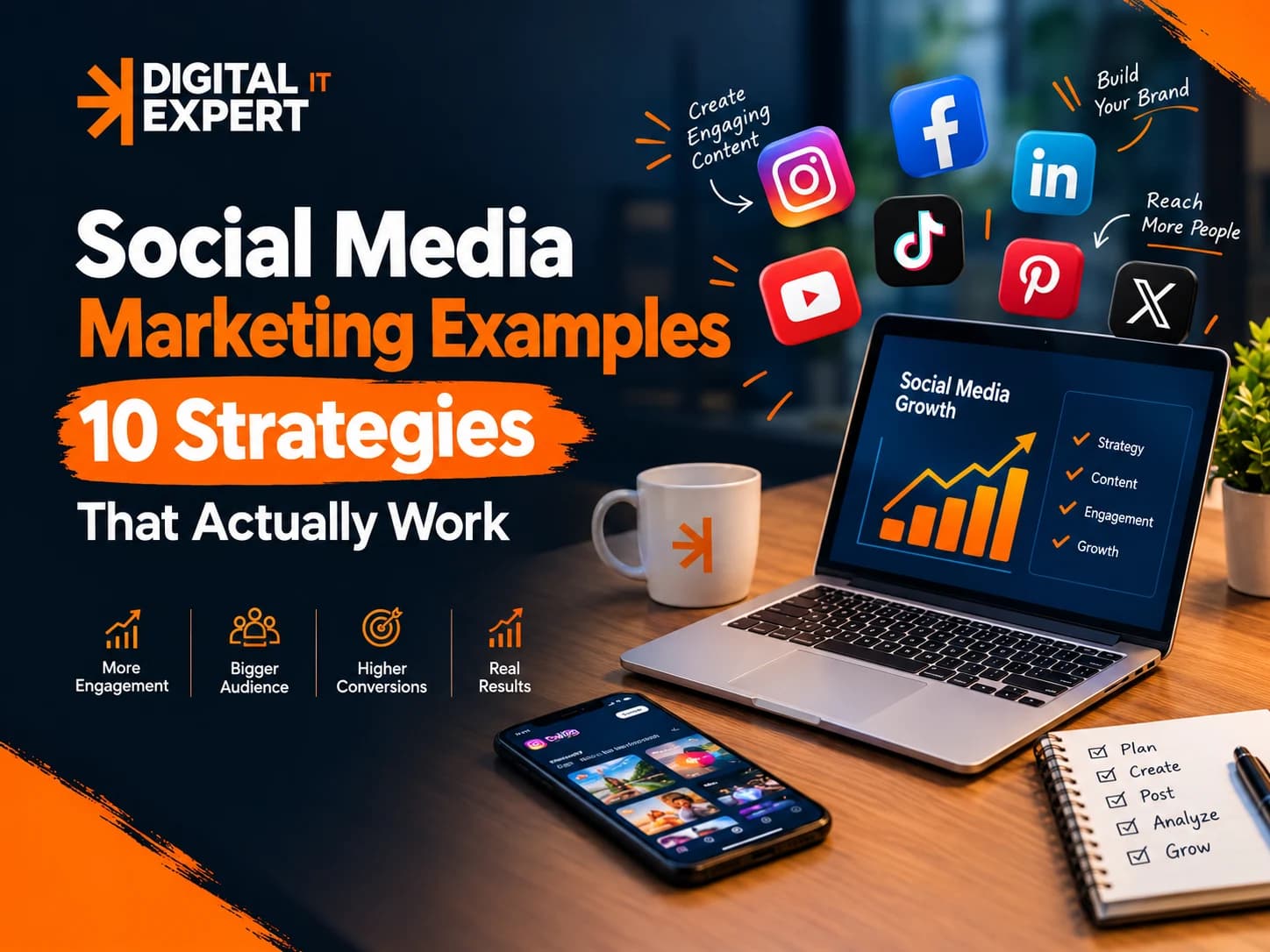 September 19, 202610 min read
Social Media Marketing Examples: 10 Strategies That Actually Work
D
Digital Expert IT
Author
Social media marketing can look simple from the outside. A business posts a photo, publishes a Reel, answers a few comments, and waits for customers to arrive.
In reality, successful social media marketing is much more intentional.
The best brands use social platforms to educate their audience, build trust, create conversations, showcase their products or services, and eventually turn attention into business. In 2026, short-form video, educational content, community engagement, paid advertising, and platform-specific content continue to play an important role in social strategies.
If you're looking for social media marketing examples that you can actually apply to your business, here are 10 practical ideas.
What Is Social Media Marketing?
Social media marketing is the process of using platforms such as Facebook, Instagram, LinkedIn, TikTok, YouTube, and Pinterest to promote a business, communicate with customers, and build a recognizable brand.
But posting regularly isn't the same thing as having a strategy.
A good social media strategy starts with a goal. That goal might be increasing brand awareness, generating leads, driving website traffic, getting more sales, or building a loyal community. From there, businesses choose the right platforms, content formats, posting approach, and metrics.
10 Social Media Marketing Examples for Businesses
1. Educational Carousel Posts
One of the easiest ways to provide value on social media is by teaching something useful.
For example, a digital marketing agency could create a carousel titled:
“5 Reasons Your Website Isn't Generating Leads.”
Each slide explains one problem and gives a simple solution.
This type of content works because it doesn't immediately ask people to buy something. Instead, it helps them solve a problem and positions the business as knowledgeable.
Other examples include:
- “7 SEO mistakes small businesses make”
- “How to improve your Facebook Ads”
- “5 website features every local business needs”
- “What should you post on Instagram?”
Educational content can also be repurposed into Reels, LinkedIn posts, blog articles, and short videos.
2. Short-Form Video Marketing
Short-form videos are now a major part of social media marketing.
A business can turn a simple idea into a 20–30 second video with a strong opening, useful information, and a clear call to action.
For example, a real estate agent might create:
“3 things to check before buying your first home.”
A web development company could make:
“Your website is slow. Here's what might be causing it.”
The key isn't expensive production. It's creating something that gives people a reason to stop scrolling.
Current marketing research continues to highlight short-form video as an important format across platforms such as Instagram and TikTok.
3. Behind-the-Scenes Content
People don't only want to see what a company sells. They also want to see the people and process behind it.
A restaurant could show how a popular dish is prepared.
A construction company could document a project from start to finish.
A marketing agency could show its team working on a campaign.
This type of social media content makes a business feel more human. It can also help customers understand the effort and expertise involved in delivering a product or service.
4. Customer Testimonials and Reviews
Social proof can be extremely useful when someone is deciding whether to trust a business.
Instead of simply saying, “We're the best,” show customers talking about their experience.
Examples include:
- Video testimonials
- Before-and-after results
- Customer screenshots
- Review graphics
- Case-study posts
- User-generated content
For example, a fitness business could share a customer's progress story, while a web agency could showcase how a redesigned website helped improve a client's online presence.
The important part is authenticity. Don't turn testimonials into exaggerated advertisements. Let the customer's experience tell the story.
5. User-Generated Content
User-generated content, or UGC, is content created by customers rather than the company itself.
A clothing brand might encourage customers to post photos wearing its products.
A restaurant could repost customers' food photos.
A software company might share a customer's workflow or success story.
This approach can create a stronger sense of community because potential customers see real people interacting with the brand.
It also gives businesses additional content without requiring every post to be produced internally.
6. Social Media Contests and Giveaways
Contests can generate attention quickly when they're designed around a clear objective.
For example:
“Share your favorite summer travel photo for a chance to win a free consultation.”
A local restaurant might ask followers to comment with their favorite menu item.
A clothing company could encourage customers to tag friends.
However, the prize and participation requirements should make sense for the target audience. A huge giveaway might generate lots of engagement but very little business if the participants aren't potential customers.
7. Product Demonstration Videos
Sometimes customers don't need another advertisement. They simply need to see how something works.
That's where demonstration content comes in.
A skincare company could show how to use a product.
A software company could demonstrate a new feature.
An electronics retailer could compare two products.
A web development company could record a quick website speed or UX demonstration.
These are excellent examples of social media marketing because the content answers a customer's question while naturally introducing the product or service.
8. Educational LinkedIn Content
LinkedIn can be especially useful for B2B businesses, consultants, agencies, recruiters, and professional service providers.
Instead of posting only company announcements, share practical knowledge.
For example:
“3 Website Problems That Quietly Cost B2B Companies Leads.”
Or:
“What I Learned After Building Websites for Small Businesses.”
You can also turn one idea into several formats: a LinkedIn text post, carousel, short video, and longer article.
The goal is to build professional credibility rather than simply fill a content calendar.
9. Social Media Advertising
Organic content isn't the only way to reach an audience.
Paid social media advertising allows businesses to promote specific offers, products, services, or content to selected audiences.
For example, a local dental clinic might run an advertisement promoting new-patient appointments.
An e-commerce company might promote a seasonal product.
A web agency might advertise a free website consultation.
The important thing is to connect the advertisement to a relevant landing page and track what happens after someone clicks.
A social media ad that receives thousands of impressions isn't necessarily successful if it produces no meaningful business result.
10. Community-Focused Content
Some of the most valuable social media marketing examples aren't focused directly on selling.
They're focused on creating a community.
A local business might highlight other businesses in its area.
A fitness coach could create a weekly Q&A.
A real estate professional could discuss local market questions.
A SaaS company could answer common customer questions publicly.
Community content encourages conversations rather than one-way promotion.
Over time, that interaction can help a business become more recognizable and trusted within its niche.
How to Choose the Right Social Media Marketing Example for Your Business
You don't need to use every strategy listed above.
Start by asking three questions:
Who is my target customer?
Understand what your audience cares about, what problems they have, and where they spend time online.
What is my business trying to achieve?
Your content should support a specific goal—such as awareness, engagement, leads, website traffic, or sales.
What can I consistently create?
A realistic strategy is better than an ambitious content calendar that your team abandons after two weeks.
For many businesses, starting with two or three platforms and creating strong, platform-specific content is more practical than trying to maintain a presence everywhere.
Build a Social Media Strategy, Not Just a Posting Schedule
The biggest mistake businesses make is treating social media as a checklist:
Monday: Post something.
Wednesday: Post something.
Friday: Post something.
Instead, think about the customer journey.
A person may first discover your brand through a Reel. Then they might see an educational carousel. Later, they may read a customer testimonial, visit your website, and eventually contact you.
That's why your social media content should work together.
If you need help turning social media activity into a complete growth strategy, you can explore Digital Expert IT and its digital marketing and business growth services.
Final Thoughts
The best social media marketing examples aren't necessarily the ones with the biggest follower counts.
They're the ones that understand their audience and create content with a purpose.
Educational carousels can build authority. Short videos can capture attention. Testimonials can build trust. Behind-the-scenes content can humanize a brand. Paid campaigns can generate targeted traffic, while community-focused posts can create long-term relationships.
The right combination depends on your business, audience, resources, and goals.
Most importantly, don't create content simply because you feel you need to post something. Create content that answers a question, solves a problem, starts a conversation, demonstrates expertise, or gives your audience a reason to remember your brand.
That people-first approach is also consistent with Google's guidance for creating useful, reliable content that provides genuine value to readers.
FAQs About Social Media Marketing Examples
1. What are some examples of social media marketing?
Common examples include educational posts, short-form videos, customer testimonials, user-generated content, product demonstrations, giveaways, influencer collaborations, community posts, and paid social media advertising.
2. What is a good social media marketing example for a small business?
Educational content, customer testimonials, behind-the-scenes videos, local community posts, and short-form videos can be practical options for small businesses because they can be created without a large production budget.
3. What are social media campaign examples?
Social media campaigns can include product launches, seasonal promotions, brand-awareness campaigns, contests, giveaways, user-generated-content campaigns, and lead-generation campaigns. A campaign normally has a defined goal, audience, timeframe, and measurement plan.
4. What type of social media content gets the most engagement?
There isn't one format that guarantees the highest engagement for every business. Current marketing research shows strong use of short-form video, educational content, Stories, humor, and interactive formats, but performance depends on the audience, platform, topic, and execution.
5. How often should a business post on social media?
There is no universal number that works for every business. A consistent schedule that your team can maintain is generally more useful than posting frequently with low-quality or repetitive content.
6. Which social media platform is best for business marketing?
The right platform depends on your audience and business model. B2B companies may benefit from LinkedIn and YouTube, while consumer brands may find Instagram and TikTok useful for discovery and engagement. The best choice should be based on where your target customers actually spend time.
7. How can social media marketing generate leads?
Businesses can use educational content, lead-generation ads, strong calls to action, landing pages, direct messages, webinars, free resources, consultations, and customer-focused offers to move social media users toward becoming leads.
8. Should businesses use paid social media advertising?
Paid advertising can be useful when a business has a clearly defined audience, offer, campaign objective, and tracking system. It should complement—not replace—a strong organic content strategy.
9. How do you measure social media marketing success?
Useful metrics can include reach, engagement, website traffic, leads, conversions, cost per lead, sales, and return on advertising spend. The most important metrics depend on the campaign's original goal.
10. What makes social media marketing successful?
Successful social media marketing usually combines a clear audience, useful content, consistent publishing, platform-specific execution, genuine engagement, strong offers, and measurement. The goal is not simply to collect likes but to create meaningful business outcomes.