49/08, Nirala Residential Area, Khulna
contact@digitalexpertit.com
←Back to Articles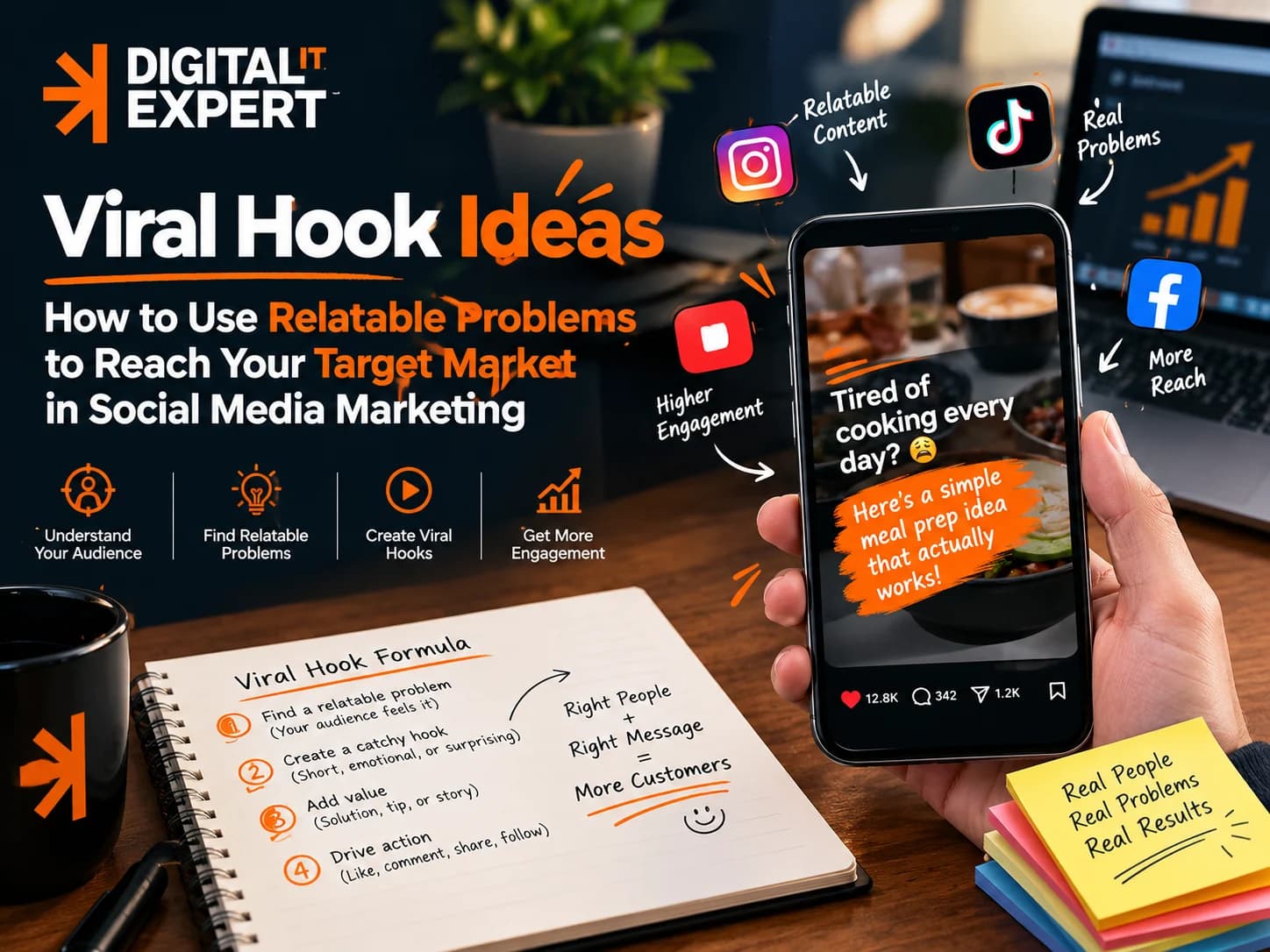 October 19, 20269 min read
Viral Hook Ideas: How to Use Relatable Problems to Reach Your Target Market in Social Media Marketing
D
Digital Expert IT
Author
Have you ever spent hours creating a social media post, only to receive a few likes and almost no comments? You're not alone. Many businesses struggle to capture attention online, even when their products or services are genuinely valuable.
Often, the problem isn't the offer. It's how the message begins.
That's why viral hook ideas based on relatable problems are so valuable in social media marketing. A strong hook makes people stop scrolling because they recognize something from their own lives. It could be a frustrating business problem, a common mistake, an unmet goal, or a question they've been asking themselves.
While no hook guarantees virality, the right opening can encourage people to watch, read, comment, and share. The key is understanding your target market and creating content that speaks directly to its needs.
What Are Viral Hooks in Social Media Marketing?
A viral hook is an opening line, visual, question, or statement designed to capture attention within the first few seconds of a video or at the beginning of a social media post.
Hooks work best when they create curiosity, highlight a problem, challenge an assumption, or promise a useful solution.
For example, a generic marketing post might say:
“Professional Social Media Marketing Services for Your Business.”
A more relatable hook could be:
“Posting every day but still getting zero inquiries? Here's what might be wrong.”
The second example identifies a recognizable frustration and gives the audience a reason to keep reading.
The goal isn't to trick people into clicking. It's to make the relevance of your content immediately clear.
Why Relatable Problems Matter for Your Target Market
People are more likely to engage with content that reflects their experiences. When a post describes a problem they genuinely face, it feels personal rather than promotional.
Consider a local restaurant owner struggling to attract customers during weekdays. A general post about digital marketing might not catch their attention. However, a hook such as “Your restaurant is busy on weekends but empty on weekdays. Here's how social media can help” speaks directly to their situation.
That is the difference between talking about your services and connecting with your audience.
Understanding your target market helps you identify:
- The problems customers face repeatedly.
- The goals they want to achieve.
- The mistakes they may not realize they're making.
- The questions they ask before purchasing.
- The reasons they hesitate to trust a service provider.
Once you understand these details, generating relevant social media hook ideas becomes much easier.
15 Viral Hook Ideas Based on Relatable Problems
Here are practical examples you can adapt for Instagram Reels, TikTok, Facebook posts, YouTube Shorts, and LinkedIn content.
1. For Small Business Owners
Small businesses often struggle with visibility, lead generation, and limited marketing budgets.
- “Getting views but no customers? Here's what your content might be missing.”
- “Your business deserves more than word-of-mouth referrals.”
- “Still relying entirely on referrals to grow your business?”
- “Three marketing mistakes that could be costing your small business customers.”
Content idea: Create a short video explaining three ways to turn social media engagement into inquiries.
2. For Real Estate Agents
Real estate professionals need visibility, qualified leads, and trust.
- “Posting property listings every day but getting no serious buyers?”
- “Your next real estate lead might be watching your content right now.”
- “Why do some real estate agents get inquiries while others get ignored?”
- “Buyers are researching online before they contact you. Is your business visible?”
Content idea: Show how property walkthrough videos, local neighborhood content, and targeted advertising can attract potential buyers.
3. For E-commerce Businesses
Online stores frequently face abandoned carts, low conversion rates, and expensive customer acquisition.
- “People visit your online store but leave without buying. Why?”
- “Your product isn't selling, but the problem might not be the price.”
- “Getting website traffic without sales? Check these three things.”
- “Customers love your products, but are they seeing them?”
Content idea: Demonstrate how product videos, customer reviews, clear product pages, and retargeting can help improve the buying experience.
4. For Restaurants and Local Businesses
Local businesses need consistent visibility and a reason for nearby customers to choose them.
- “Your tables are empty on weekdays. Have you tried this marketing approach?”
- “People live near your restaurant but don't know you exist.”
- “Great food isn't enough if local customers never discover your restaurant.”
Content idea: Create a Reel showing popular menu items, customer favorites, behind-the-scenes preparation, or a limited-time offer.
5. For B2B Companies and Service Providers
B2B audiences often care more about results, efficiency, and solving operational problems than flashy promotions.
- “Still managing your entire business with spreadsheets?”
- “Your team is busy all day, but are your processes actually efficient?”
- “Losing leads because nobody follows up on time?”
- “Your website looks professional, but does it generate qualified leads?”
Content idea: Explain how automation, conversion-focused website design, and better lead tracking can help businesses improve their processes.
How to Create Viral Hook Ideas for Your Specific Audience
You don't need to depend on random inspiration. A repeatable process can help you create stronger hooks every week.
Step 1: Choose One Specific Audience
Avoid writing for everyone. Choose a clearly defined group, such as restaurant owners, real estate agents, online store owners, or local service providers.
The more specific your audience, the easier it becomes to identify relevant problems.
Step 2: Identify One Pain Point
Choose a problem your audience genuinely experiences. Examples include low engagement, inconsistent sales, poor website conversions, or difficulty generating qualified leads.
Focus on one problem per post rather than trying to solve everything at once.
Step 3: Turn the Problem Into a Hook
Use a simple formula:
Relatable problem + curiosity + potential solution
For example:
“Your Instagram gets likes but no leads. Here's one change worth testing.”
Another approach is to challenge a common assumption:
“Posting more often won't necessarily fix your social media engagement.”
These openings create interest without promising unrealistic results.
Step 4: Deliver on the Promise
A strong hook is only the beginning. The content that follows must provide a useful explanation, demonstration, example, or actionable tip.
If your opening promises three solutions, deliver three meaningful solutions. Misleading hooks may attract temporary attention but can damage audience trust.
Step 5: Test and Improve
Publish different versions of your hooks and compare their performance. Look beyond likes to measure watch time, saves, shares, meaningful comments, profile visits, website clicks, and qualified inquiries.
Over time, these results can reveal which problems matter most to your target market.
Common Mistakes to Avoid When Writing Social Media Hooks
Even a clever opening can fail when the message misses the audience's needs.
Being too generic: “Want to grow your business?” doesn't identify a specific problem. Add context to make the message more relevant.
Using misleading clickbait: Avoid exaggerated claims such as guaranteed sales or overnight success. Curiosity should be honest.
Ignoring the platform: A short video needs an immediate opening, while a LinkedIn post may benefit from a thoughtful business observation. Adapt the format to the channel.
Forgetting the next step: Give viewers a reason to continue, save the post, share their experience, or visit a relevant page.
Copying competitors without context: Successful hooks can inspire you, but your content should reflect your own audience, expertise, and services.
Turn Better Hooks Into a Smarter Marketing Strategy
Viral hooks can help attract attention, but sustainable growth requires more than views. Your social media content should connect with a broader strategy that includes audience research, consistent publishing, clear messaging, and a conversion path.
For example, a business might use educational Reels to attract attention, a website to explain its services, and a contact form to generate qualified inquiries.
This is where Digital Expert IT can support businesses looking to strengthen their online presence through digital solutions. A coordinated strategy combining content creation, advertising, website development, and SEO can help connect audience engagement with meaningful business goals.
Explore the available digital marketing and business growth services to learn more about building a stronger online marketing presence.
Conclusion
The most effective viral hook ideas often begin with a simple question: What problem is my target audience already thinking about?
When you understand your audience's frustrations, goals, and everyday challenges, you can create social media content that feels relevant instead of forced.
Start with one audience, choose one relatable problem, write a clear hook, and deliver genuine value. Test different approaches and learn from the results.
You can't guarantee that every post will go viral. However, you can consistently create content that earns attention, builds trust, and gives the right people a reason to engage with your business.
FAQs About Viral Hook Ideas and Social Media Marketing
1. What are the best viral hook ideas for social media marketing?
The best hooks address a specific audience problem, create curiosity, or offer a useful insight. Examples include “Getting views but no sales?” and “Three marketing mistakes costing your business leads.” Choose hooks that reflect your customers' actual challenges.
2. How do I find relatable problems for my target market?
Review customer questions, comments, reviews, sales conversations, competitor discussions, and frequently asked questions. Look for recurring frustrations, purchasing objections, and goals. Use those insights to develop relevant content topics.
3. How do I write a hook that makes people stop scrolling?
Start with a clear problem, surprising observation, or relevant question. Keep the opening concise, use language your audience understands, and make sure the rest of the content delivers on the promise.
4. Do viral hooks work for small businesses?
Yes. Small businesses can use relatable hooks to introduce their services, answer customer questions, demonstrate expertise, and build relationships with potential customers. Results depend on content quality, audience relevance, distribution, and the offer.
5. What are some viral hook ideas for Instagram Reels?
Try openings such as “Stop making this mistake with your business Instagram,” “Why your Reels get views but no inquiries,” or “Three things I would fix before running another ad.” Pair the opening with relevant visuals and practical advice.
6. How many words should a social media hook have?
There is no universal ideal length. A hook should be long enough to communicate the problem clearly but short enough to understand quickly. For short-form videos, concise openings are often useful; for longer posts, a more detailed opening may work.
7. Can viral hooks help generate leads and sales?
They can attract relevant attention and encourage people to explore your content. To generate leads, connect your hooks to useful information, a relevant service or product, and a clear next step. Views alone do not guarantee sales.
8. How often should I test new social media hooks?
Test new hooks regularly as part of your content schedule. Compare similar posts where possible, track meaningful engagement and conversions, and reuse successful approaches without repeating the exact same message every time.