49/08, Nirala Residential Area, Khulna
contact@digitalexpertit.com
←Back to Articles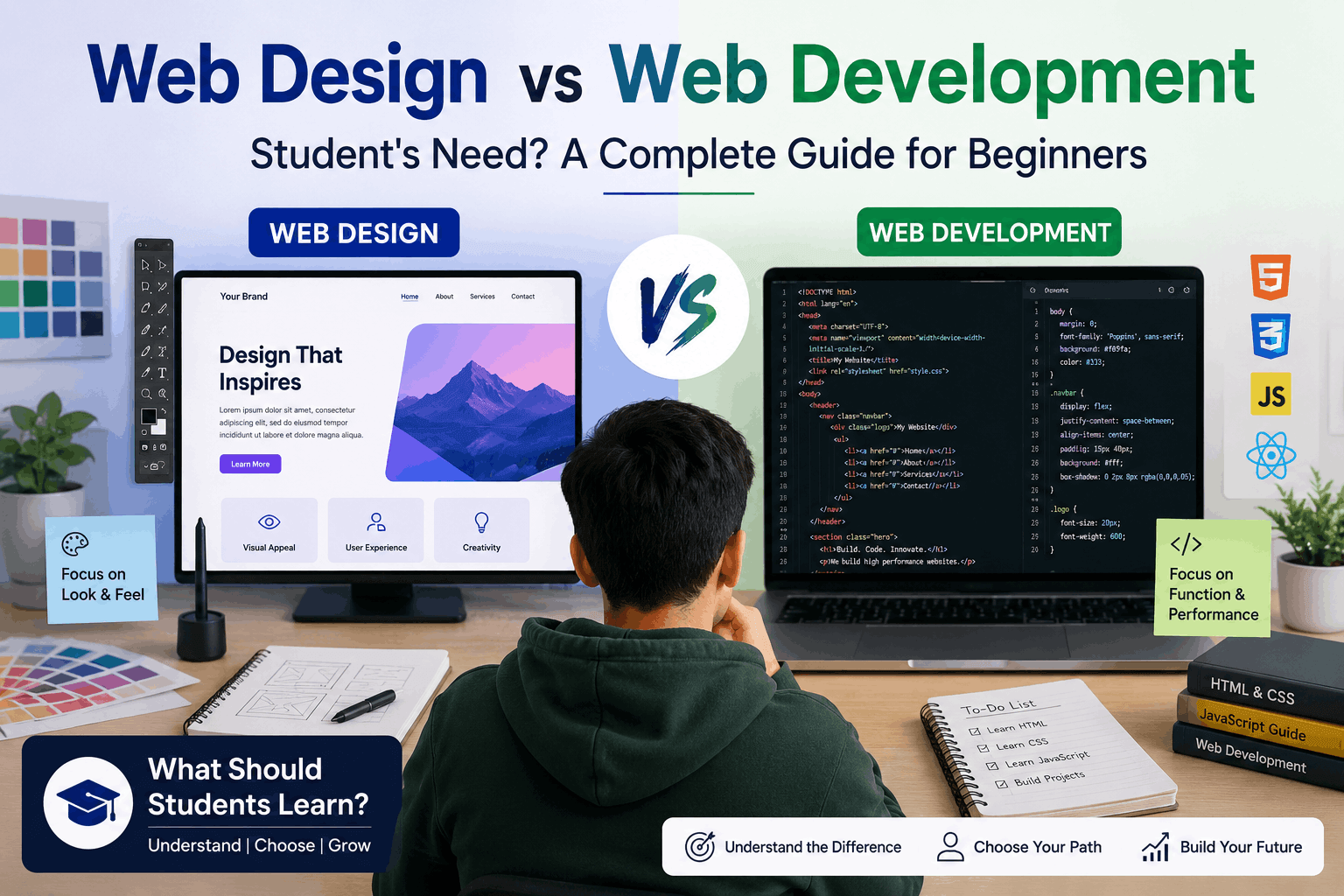 June 18, 20267 min read
Web Design vs Web Development – Student's Need? A Complete Guide for Beginners
D
Digital Expert IT
Author
When students start exploring careers in technology, one question comes up repeatedly: Web Design vs Web Development – Student's Need?
Many students hear these terms used together and assume they mean the same thing. In reality, web design and web development are two different skill sets, career paths, and learning journeys. While they often work together to create websites, the responsibilities and required skills are quite different.
If you're a student wondering which path is right for you, this guide will help you understand the key differences, career opportunities, required skills, and how to choose the best option based on your interests and goals.
What Is Web Design?
Web design focuses on the visual appearance and user experience of a website. A web designer is responsible for creating layouts, selecting colors, choosing typography, and ensuring visitors can easily navigate a website.
Think of a web designer as the architect of a house. They decide how everything should look and feel before construction begins.
Key Responsibilities of a Web Designer
- Creating website layouts and wireframes
- Designing user interfaces (UI)
- Improving user experience (UX)
- Selecting colors, fonts, and visual elements
- Ensuring responsive design for mobile devices
- Building design prototypes
Skills Required for Web Design
Students interested in web design should focus on:
- UI/UX Design
- Figma
- Adobe XD
- Adobe Photoshop
- Color Theory
- Typography
- User Research
- Responsive Design Principles
Who Should Choose Web Design?
Web design is ideal for students who:
- Enjoy creativity and visual storytelling
- Like designing graphics and layouts
- Have an eye for aesthetics
- Enjoy solving user experience problems
- Prefer design over coding
If you enjoy creating visually appealing content and thinking about how users interact with digital products, web design may be the perfect fit.
What Is Web Development?
Web development focuses on building and maintaining the functionality of a website. Developers turn designs into fully working websites using programming languages and frameworks.
If web designers create the blueprint, web developers build the actual structure.
Key Responsibilities of a Web Developer
- Writing code
- Developing website functionality
- Building databases
- Creating APIs
- Optimizing website performance
- Fixing bugs and technical issues
- Ensuring website security
Skills Required for Web Development
Students interested in web development should learn:
- HTML
- CSS
- JavaScript
- React.js
- Next.js
- Node.js
- Express.js
- MongoDB
- SQL Databases
- Git and GitHub
Who Should Choose Web Development?
Web development is ideal for students who:
- Enjoy coding and problem-solving
- Love building things from scratch
- Have analytical thinking skills
- Enjoy technology and software systems
- Like logical challenges
Students who enjoy programming and technical problem-solving often find web development more rewarding.
Web Design vs Web Development: Major Differences
|
Feature |
Web Design |
Web Development |
|
Primary Focus |
Visual Appearance |
Website Functionality |
|
Main Tools |
Figma, Adobe XD |
VS Code, GitHub |
|
Coding Required |
Minimal or None |
Extensive Coding |
|
Creativity Level |
High |
Medium |
|
Technical Complexity |
Moderate |
High |
|
Career Path |
Designer, UI/UX Specialist |
Front-End, Back-End, Full-Stack Developer |
|
Learning Curve |
Easier for Beginners |
More Technical |
Both fields are valuable, but the right choice depends on your interests and career goals.
Why Students Should Learn Web Design or Web Development
The digital economy continues to grow rapidly. Businesses of all sizes need websites, online stores, web applications, and digital platforms.
As a result, demand for skilled web professionals remains strong worldwide.
Benefits for Students
1. High Career Demand
Companies constantly need web designers and developers to build and maintain online platforms.
2. Freelancing Opportunities
Students can earn income through freelance projects while studying.
3. Remote Work Flexibility
Many web-related jobs allow remote work from anywhere in the world.
4. Entrepreneurial Opportunities
Students can build their own websites, startups, portfolios, and digital businesses.
5. Continuous Learning
The industry evolves quickly, creating opportunities for long-term career growth.
Can Students Learn Both?
Absolutely.
In fact, many successful professionals start by learning one area and gradually expand into the other.
For example:
- A designer may learn HTML and CSS to better communicate with developers.
- A developer may learn UI/UX principles to create better user experiences.
Students who understand both design and development become highly valuable in the job market.
Many businesses prefer professionals who can bridge the gap between creativity and technology.
Which Career Has Better Job Opportunities?
Both fields offer excellent opportunities, but web development generally has a larger number of technical job openings.
Popular Web Design Careers
- UI Designer
- UX Designer
- Product Designer
- Graphic Designer
- Design Consultant
Popular Web Development Careers
- Front-End Developer
- Back-End Developer
- Full-Stack Developer
- Software Engineer
- Web Application Developer
Full-stack developers are particularly in demand because they can handle both front-end and back-end responsibilities.
How Students Can Start Learning Today
The good news is that students don't need expensive degrees to begin learning.
Start with these steps:
For Web Design
- Learn design fundamentals.
- Master Figma.
- Study UX principles.
- Create portfolio projects.
- Practice redesigning existing websites.
For Web Development
- Learn HTML and CSS.
- Study JavaScript fundamentals.
- Build simple projects.
- Learn React and modern frameworks.
- Create a portfolio website.
Students looking for professional web solutions and industry-level development examples can explore the services offered by Digital Expert IT's web development and digital solutions.
You can also learn more about the company, its expertise, and digital services through Digital Expert IT.
The Future of Web Design and Web Development
Artificial Intelligence, automation, and modern frameworks are transforming the industry. However, creativity and problem-solving remain irreplaceable skills.
Businesses will always need:
- Better user experiences
- Faster websites
- Mobile-friendly designs
- Secure web applications
- Custom digital solutions
This means students entering either field today can expect strong career opportunities in the coming years.
Conclusion
When comparing Web Design vs Web Development – Student's Need?, there is no one-size-fits-all answer.
Choose web design if you enjoy creativity, visual communication, and user experiences.
Choose web development if you enjoy coding, logic, and building functional digital products.
If possible, learn both. A combination of design and development skills can significantly increase your career opportunities and make you a more versatile professional.
The most important step is simply getting started. Whether you choose design, development, or both, the skills you learn today can open doors to exciting opportunities in the future.
Frequently Asked Questions (FAQs)
1. What is the main difference between web design and web development?
Web design focuses on the appearance and user experience of a website, while web development focuses on coding and functionality.
2. Which is easier for students: web design or web development?
Most beginners find web design easier because it requires less technical knowledge. Web development typically involves a steeper learning curve due to programming concepts.
3. Can I learn web design and web development together?
Yes. Many students start with one field and gradually learn the other. Understanding both can improve career opportunities.
4. Is web development a good career for students?
Yes. Web development remains one of the most in-demand digital skills globally, offering freelance, remote, and full-time career opportunities.
5. Do web designers need coding skills?
Not always. However, learning basic HTML and CSS can help designers collaborate more effectively with developers.
6. Which career pays more: web design or web development?
Compensation varies by location and experience, but web developers generally earn higher average salaries due to the technical nature of the work.
7. How long does it take to learn web development?
Students can learn the basics in a few months, but becoming job-ready often takes 6–12 months of consistent practice and project building.
8. Is web design still in demand in 2026?
Yes. Businesses continue to prioritize user experience, mobile responsiveness, and modern design, keeping web design skills highly valuable.
9. Should students learn UI/UX design before web development?
Not necessarily. However, understanding UI/UX principles can help developers create better websites and applications.
10. What is the best career choice for creative students?
Creative students often enjoy web design, UI design, UX design, and product design because these roles focus heavily on visual communication and user experience.